BECKER NEVUS
BECKER NEVUS ICD-10: D22,502
• Becker nevus is a distinctive asymptomatic clinical lesion that is a pigmented hamartoma, that is, a developmental anomaly consisting of changes in pigmentation, hair growth, and a slightly elevated smooth verrucous surface (Fig. 9-40).
• It occurs mostly in males and in all races. It appears not at birth but usually before 15 years of age, although sometimes after this age.
• The lesion is predominantly a macule but can have a slight verrucous surface not unlike the lesion of acanthosis nigricans. It is light brown in color and has a geographic pattern with sharply demarcated borders (Fig. 9-40A).
• Most common locations are the shoulders and the back. The increased hair growth follows the onset of the pigmentation and is localized to the areas that are pigmented (Fig. 9-40B). The pigmentation is related to increased melanin in basal cells and not to an increased number of melanocytes.
• It is differentiated from a hairy congenital melanocytic nevus, because Becker nevus is not usually present at birth, and from café-au-lait macules because these are not hairy.
• The lesion extends for a year or two and then remains stable, only rarely fading.
• There is very rarely hypoplasia of underlying structures, e.g., shortening of the arm or reduced breast development in areas under the lesion.
• Management: The hypertrichosis can be of cosmetic concern to some individuals.
A
B
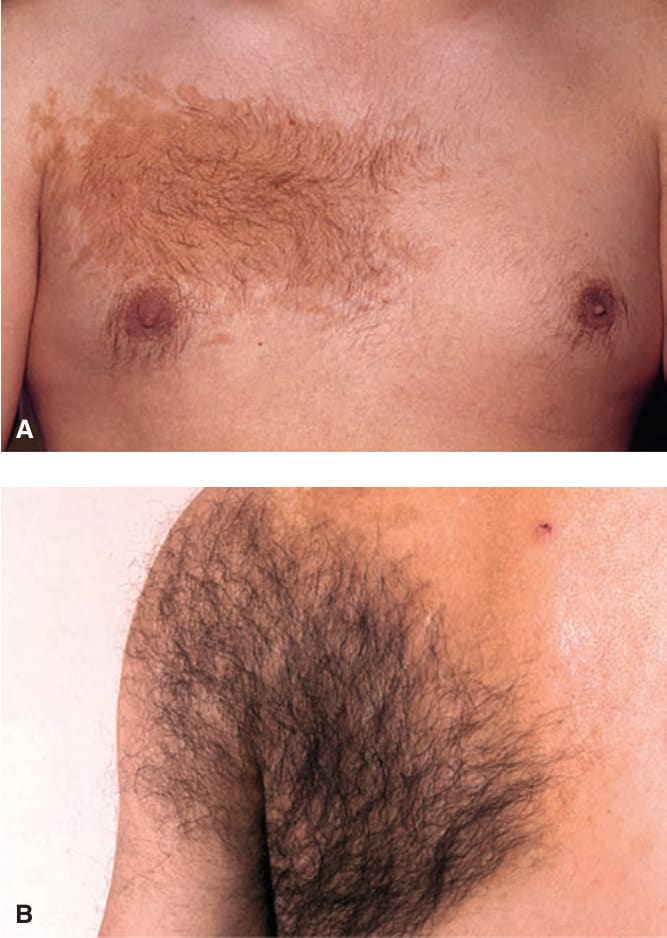
FIGURE 9-40 • A and B Becker nevus (A) A slightly raised light-tan plaque with sharply defined and highly irregular border and slight hypertrichosis on the chest of a 16-year-old male patient. (B) In this case of Becker nevus, the massive hypertrichosis conceals the tan background plaque.