IRRITANT CONTACT DERMATITIS (ICD)
IRRITANT CONTACT DERMATITIS (ICD) ICD-10: L24
• ICD is a localized disease confined to areas exposed to irritants.
• It is caused by exposure of the skin to chemical or other physical agents that are capable of irritating the skin.
• Severe irritants cause toxic reactions even after short exposure.
• Most cases are caused by chronic cumulative exposure to one or more irritants.
• The hands are the most commonly affected area.
EPIDEMIOLOGY
ICD is the most common form of occupational skin disease, accounting for up to 80% of all occupational skin disorders. However, ICD need not be occupational and can occur in anyone being exposed to a substance irritant or toxic to the skin.
ETIOLOGY
ETIOLOGIC AGENTS (Table 2-1) Abrasives, cleaning agents, oxidizing agents; reducing agents, plants, and animal enzymes, secretions; desiccant powders, dust, and soils; excessive exposure to water. PREDISPOSING FACTORS Atopy, fair skin, temperature (low), climate (low humidity), occlusion, and mechanical irritation. OCCUPATIONAL EXPOSURE Individuals engaged in the following occupations/activities are at risk: medical, dental, or veterinary services; housekeeping, hairdressing, cleaning, floral arranging, agriculture, horticulture, forestry, food preparation and catering, printing, painting, metal work, mechanical engineering, car maintenance, construction, and fishing.
PATHOGENESIS
Irritants (both chemical and physical), if applied for sufficient time and in adequate concentration. The initial reaction is usually limited to the site of contact with the irritant. Mechanisms involved in acute and chronic phases of ICD are different. Acute reactions
Solvents including water
Detergents
Disinfectants
Antiwrinkle medicaments
Source: Reproduced with permission from Kang S, Amagai M, Bruckner AL, Enk AH, Margolis DJ, McMichael AJ, Orringer JS, eds. Fitzpatrick’s Dermatology. 9th ed. New York, McGraw Hill; 2019, Table 25-3.
result from direct cytotoxic damage to keratinocytes. Chronic ICD results from repeated exposures that cause damage to cell membranes, disrupting the skin barrier and leading to protein denaturation and then cellular toxicity.
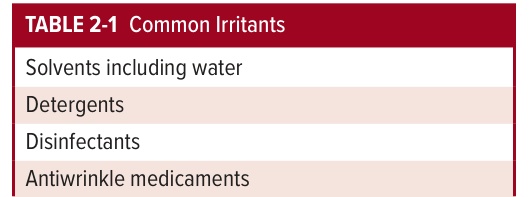
TABLE 2-1 Common Irritants