ACUTE IRRITANT CONTACT DERMATITIS
ACUTE IRRITANT CONTACT DERMATITIS
CLINICAL MANIFESTATION
SYMPTOMS Subjective symptoms (burning, stinging, or smarting) can occur within seconds after exposure (immediate-type stinging), for example, to acids, chloroform, and methanol. Delayed-type stinging occurs within 1 to 2 minutes, peaking at 5 to 10 minutes, fading by 30 minutes, and is caused by agents such as aluminum chloride, phenol, propylene glycol, and others. In delayed ICD, objective skin symptoms do not start until 8 to 24 hours after exposure (e.g., anthralin, ethylene oxide, and benzalkonium chloride) and are accompanied by burning rather than itching. SKIN FINDINGS Minutes after exposure or delayed up to ≥24 hours. Lesions range from erythema to vesiculation (Figs. 2-1 and 2-2) and caustic burn with necrosis. Sharply demarcated erythema and superficial edema, corresponding to the application site of the toxic substance (Fig. 2-1). Lesions do not spread beyond the site of contact. In more severe reactions, vesicles and blisters (Figs. 2-1 and 2-2) → erosions and/or even frank necrosis, as with acids or alkaline solutions. No papules. Configuration is often bizarre or linear (“outside job” or dripping effect) (Fig. 2-1).
Distribution Isolated, localized, or generalized, depending on contact with toxic agent.
Duration Days, weeks, depending on tissue damage.
Constitutional Symptoms Usually none, but in widespread acute ICD “acute illness” syndrome, fever may occur.
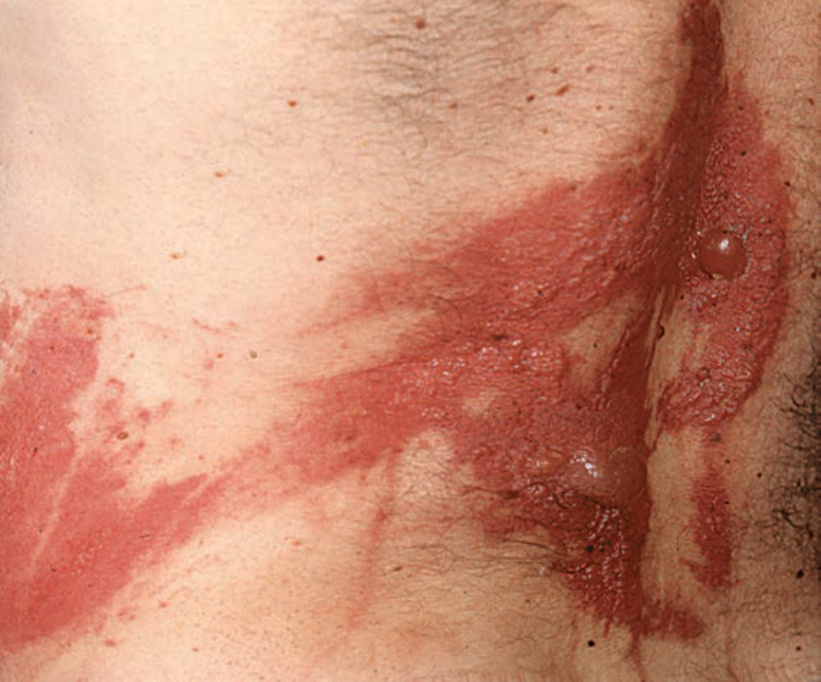
FIGURE 2-1 • Acute irritant contact dermatitis following application of a cream containing nonylvanillamid and nicotinic acid butoxyethyl ester prescribed for lower back pain The “streaky pattern” indicates an outside job. The eruption is characterized by a massive erythema with vesiculation and blister formation, and is confined to the sites exposed to the toxic agent.
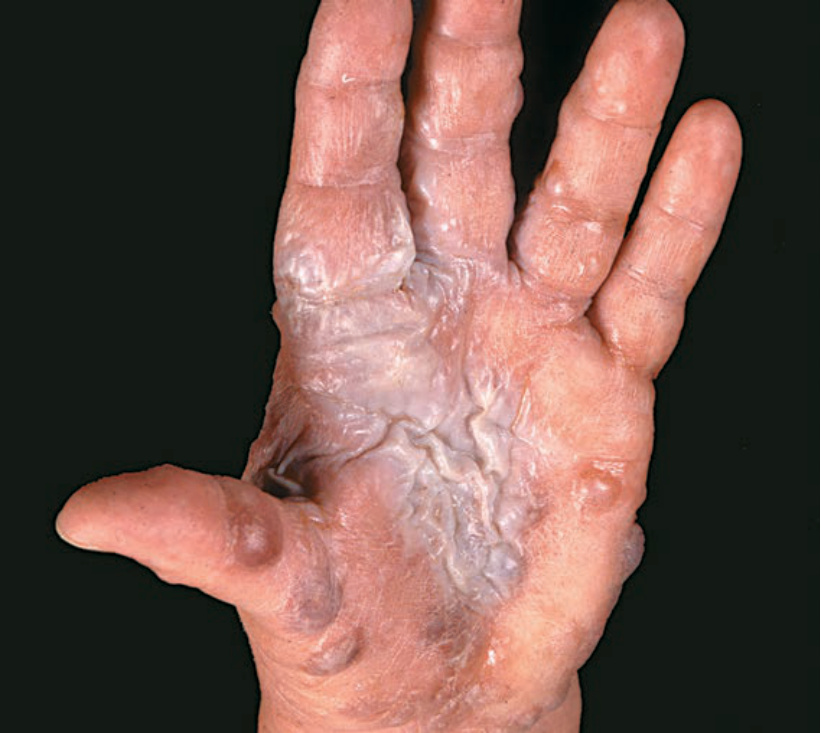
FIGURE 2-2 • Acute irritant contact dermatitis on the hand resulting from an industrial solvent There is massive blistering on the palm.