CHRONIC IRRITANT CONTACT DERMATITIS
CHRONIC IRRITANT CONTACT DERMATITIS
CUMULATIVE ICD Most common; develops slowly after repeated additive exposure to mild irritants (water, soap, detergents, etc.), usually on the hands. Repeated exposures to toxic or subtoxic concentrations of offending agents → disturbance of the barrier function that allows even subtoxic concentrations of the offending agent to penetrate into the skin and elicit a chronic inflammatory response. Injury (e.g., repeated rubbing of the skin), prolonged soaking in water, or chronic contact after repeated, cumulative physical trauma such as friction, pressure, and abrasions in individuals engaged in manual work (traumatic ICD).
CLINICAL MANIFESTATION
SYMPTOMS Stinging, smarting, burning, and itching; pain as fissures develop. SKIN FINDINGS Dryness → chapping → erythema (Fig. 2-3) → hyperkeratosis and scaling → fissures and crusting (Fig. 2-4). Sharp
margination gives way to ill-defined borders, lichenification.
Distribution Usually on the hands (Figs. 2-3 and 2-4). Usually starting at finger web spaces, spreading to the sides and dorsal surface of the hands, and then to the palms. In housewives, it often starts on the fingertips (pulpitis) (Fig. 2-3). Rarely seen in other locations exposed to irritants and/or trauma, for example, in violinists on mandible or neck, or on exposed sites as in airborne ICD (see below).
Duration Chronic or months to years.
Constitutional Symptoms None, except when infection occurs. Chronic ICD (e.g., hand dermatitis; see below) can become a severe occupational and emotional problem.
LABORATORY EXAMINATION
HISTOPATHOLOGY In acute ICD, epidermal cell necrosis, neutrophils, vesiculation, and necrosis. In chronic ICD, acanthosis, hyperkeratosis, and lymphocytic infiltrate. PATCH TESTS These are negative in ICD unless ACD is also present (see below).
A
B
may require allocation to another job; atopic individuals have a worse prognosis. In cases of chronic subcritical levels of irritant, some workers develop tolerance or “hardening.”
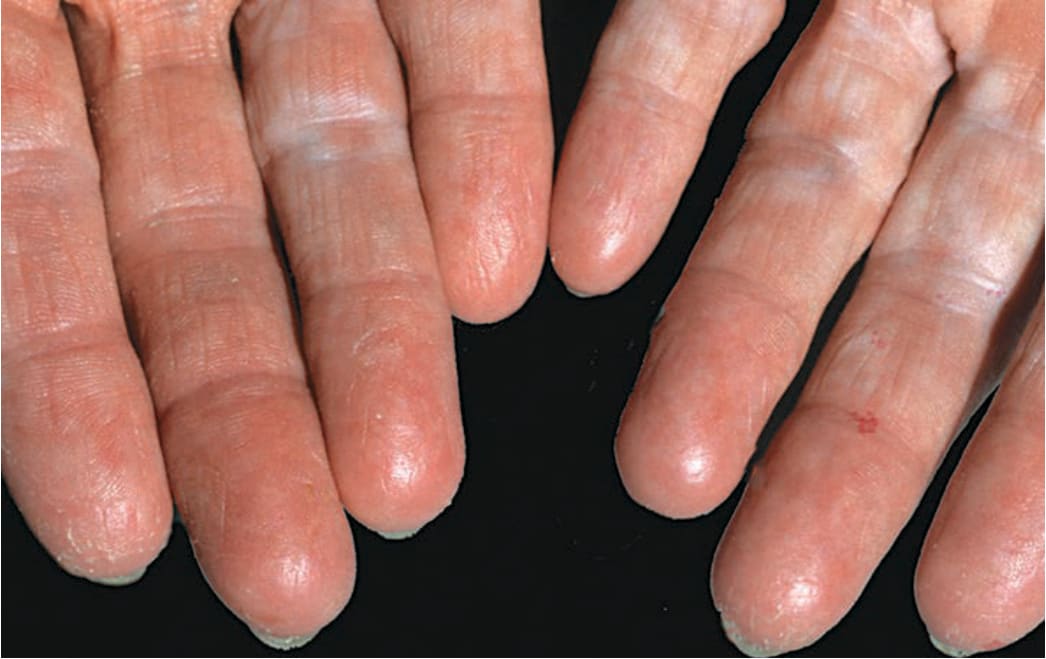
FIGURE 2-3 • Early chronic irritant contact dermatitis in a housewife This has resulted from repeated exposure to soaps and detergents. Note glistening fingertips (pulpitis).
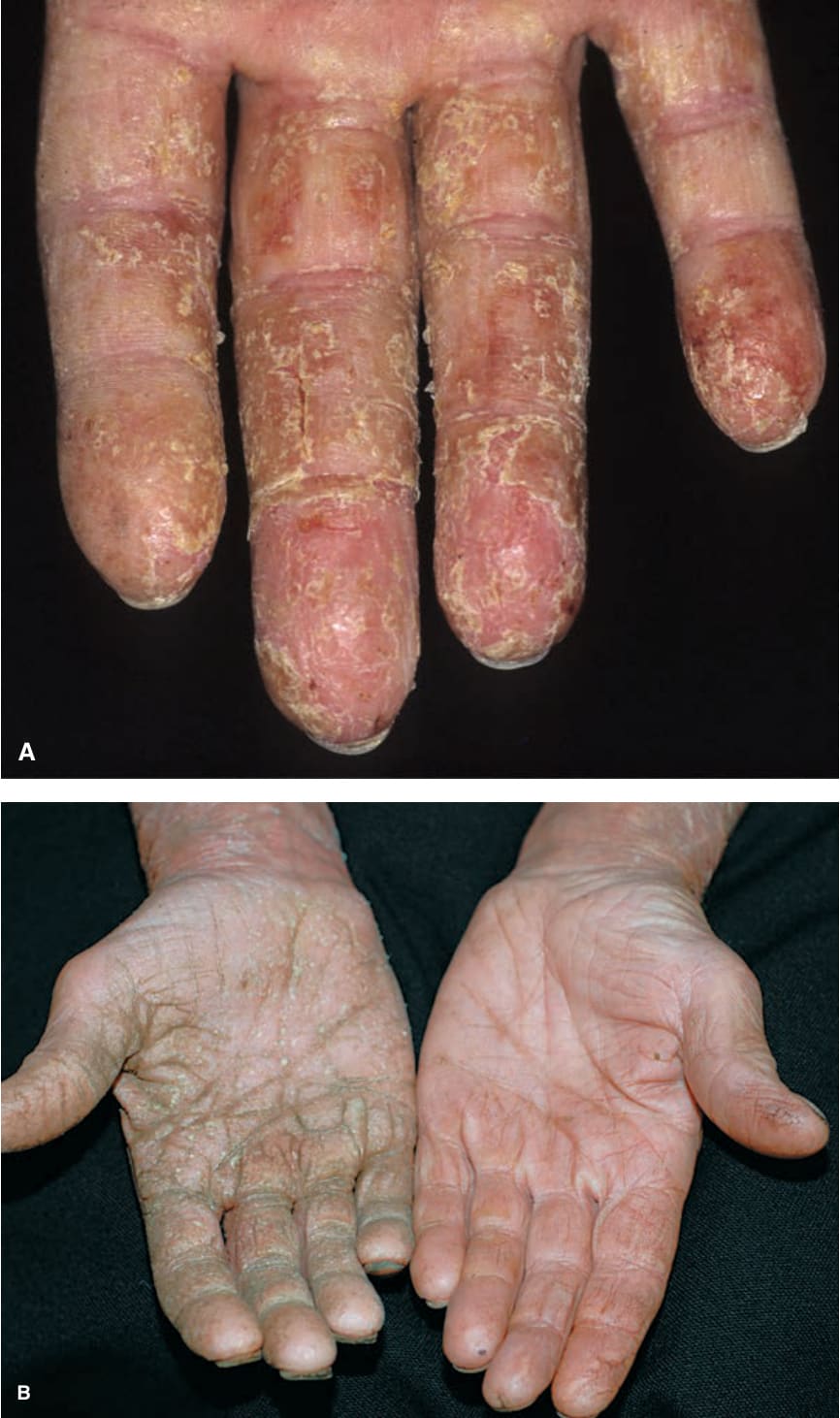
FIGURE 2-4 • (A) Chronic irritant dermatitis with acute exacerbation in a housewife The patient used turpentine to clean her hands after painting. Erythema, fissuring, and scaling. Differential diagnosis is allergic contact dermatitis and palmar psoriasis. Patch tests to turpentine were negative. (B) Irritant contact dermatitis in a construction worker who works with cement Note the hyperkeratoses, scaling, and fissuring. There is also minimal pustulation. Note that right (dominant working) hand is more severely affected than the left hand.