LICHEN SIMPLEX CHRONICUS (LSC)
LICHEN SIMPLEX CHRONICUS (LSC) ICD-10: L28
• A special localized form of lichenification, occurring in circumscribed plaques.
• Occurs in individuals older than 20 years, is more frequent in women, and possibly more frequent in Asians.
• Results from repetitive rubbing and scratching.
• Skin symptoms consist of pruritus, often in paroxysms, when the rubbing becomes automatic and reflexive, like an unconscious habit.
• Lichenification is a characteristic feature of AD, whether generalized or localized.
• A solid plaque of lichenification, arising from the confluence of small papules (Fig. 2-18). Skin is palpably thickened; skin markings (barely visible in normal skin) are accentuated and can be readily seen. Excoriations. Usually sharply defined. Isolated single lesion or several plaques. Nuchal area (female) (Fig. 2-18), scalp, ankles, lower legs, upper thighs, exterior forearms, vulva, pubis, anal area, scrotum, and groin. In African American and dark skin tones, lichenification may assume a special type of pattern consisting of multiple small (2 to 3 mm) closely set papules, a “follicular” pattern (as in Fig. 2-14B).
• Lichen simplex chronicus can last for decades unless the rubbing and scratching are stopped by treatment.
• Differential diagnosis includes a chronic pruritic plaque of psoriasis vulgaris, early stages of mycosis fungoides, ICD, ACD, and epidermal dermatophytosis.
• Management Difficult. Explain to the patient that rubbing and scratching must be stopped. Occlusive bandages can be used. Topical glucocorticoid preparations or tar preparations covered by occlusive dressings; if left for 24 h, glucocorticoids incorporated in adhesive plastic tape are also effective.
• Intralesional triamcinolone is often highly effective in smaller lesions (3 to 5 mg/mL; higher concentrations may cause atrophy). Oral hydroxyzine, 25 to 50 g at night, may be helpful.
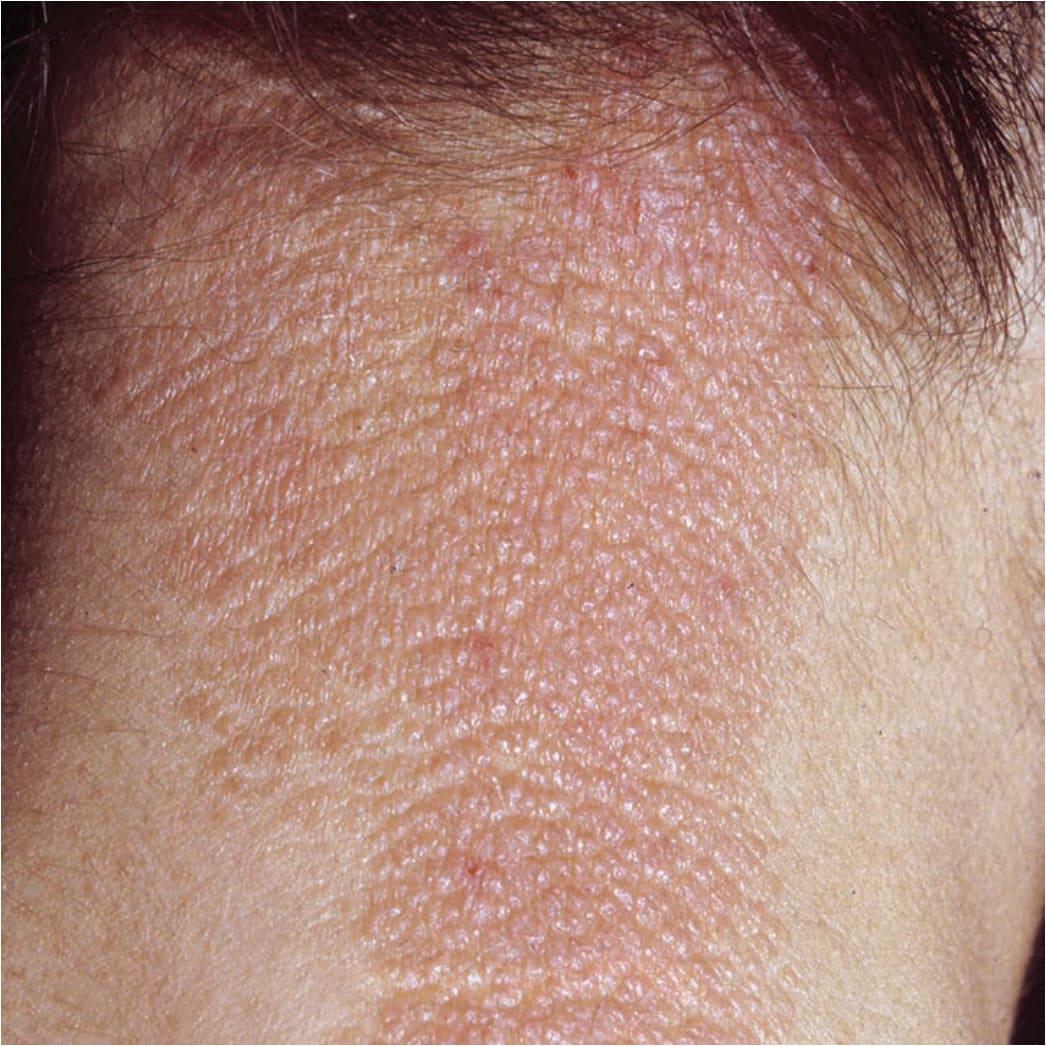
FIGURE 2-18 • Lichen simplex chronicus Confluent, papular, follicular eczema, creating a plaque of lichen simplex chronicus of the posterior neck and occipital scalp. The condition had been present for many years as a result of chronic rubbing of the area.