PRURIGO NODULARIS (PN)
PRURIGO NODULARIS (PN) ICD-10: L28.1
• Often associated with AD but can occur without AD.
• PN patients with AD are younger and have reactivity to environmental allergens; nonatopic PN patients are older and lack hypersensitivities to environmental allergens.
• PN usually occurs in younger or middle-aged females, who often exhibit signs of neurotic stigmatization.
• PN starts with piercing pruritus that leads to picking and scratching.
• Dome-shaped nodules—several millimeters to 2 cm—develop on sites in which persistent itching and scratching occur (Fig. 2-19). Nodules are often eroded, excoriated, and sometimes even ulcerated as patients dig into them with their nails.
• Usually multiple on the extremities.
• Lesions persist for months after the trauma has been discontinued.
• Treatment: intralesional triamcinolone, occlusive dressings with high-potency glucocorticoids. In severe cases, methotrexate, cyclosporine, or thalidomide. Watch out for contraindications. Neuromodulators, such as gabapentin, can be helpful.
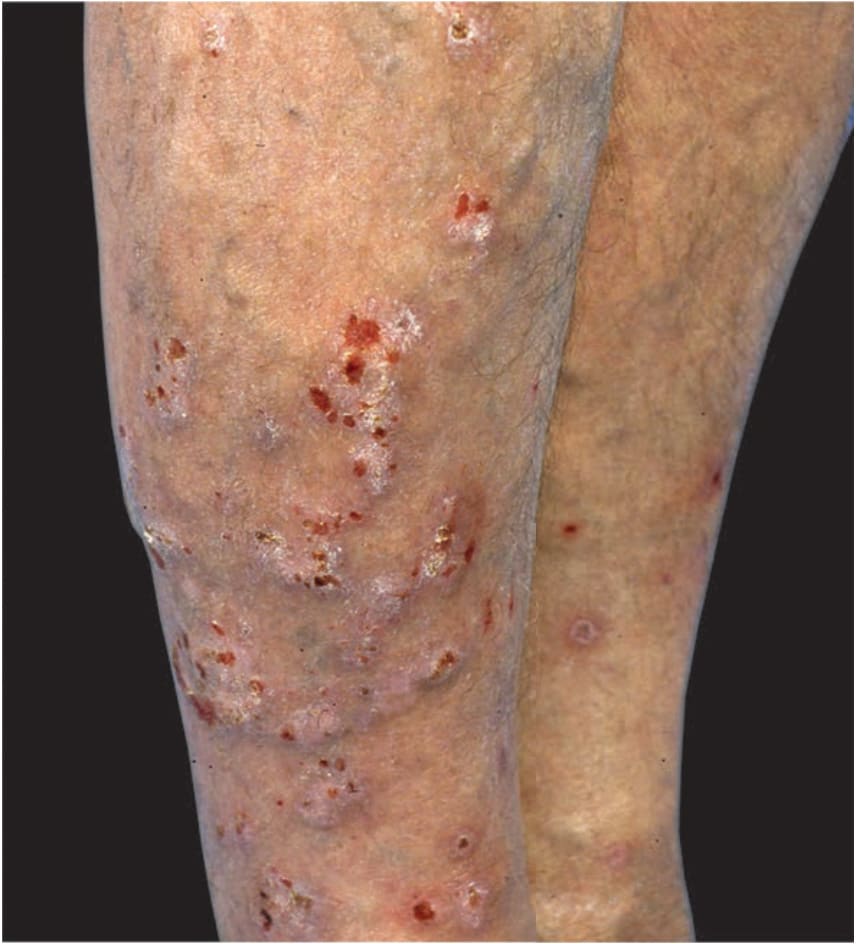
FIGURE 2-19 • Prurigo nodularis Multiple, firm, excoriated nodules arising at sites of chronically picked or excoriated skin. Often occurring in patients with atopy but also without it. In this 56-year-old patient, the extreme pruritus necessitated multiple hospitalizations.