AUTOSENSITIZATION DERMATITIS
AUTOSENSITIZATION DERMATITIS ICD-10: L30.9
• An often unrecognized generalized pruritic dermatitis directly related to a primary dermatitis elsewhere.
• For example, a patient with venous stasis dermatitis on the lower legs may develop pruritic, symmetric, scattered, erythematous, maculopapular, or papulovesicular lesions on the trunk, forearms, thighs, or legs.
• These persist and spread until the basic underlying primary dermatitis is controlled.
• Similarly, autosensitization may occur as an “id” reaction in inflammatory tinea pedis and manifests as a dyshidrosiform, vesicular eruption on the feet and hands (Fig. 2-22) and papulovesicular eczematoid lesions on the trunk.
• The phenomenon results from the release of cytokines in the primary dermatitis, as a result of sensitization. These cytokines circulate in the blood and heighten the sensitivity of the distant skin areas.
• The diagnosis of autosensitization dermatitis is often post hoc; that is, the distant eruption disappears when the primary dermatitis is controlled.
• Oral glucocorticoids hasten the disappearance of the lesions.
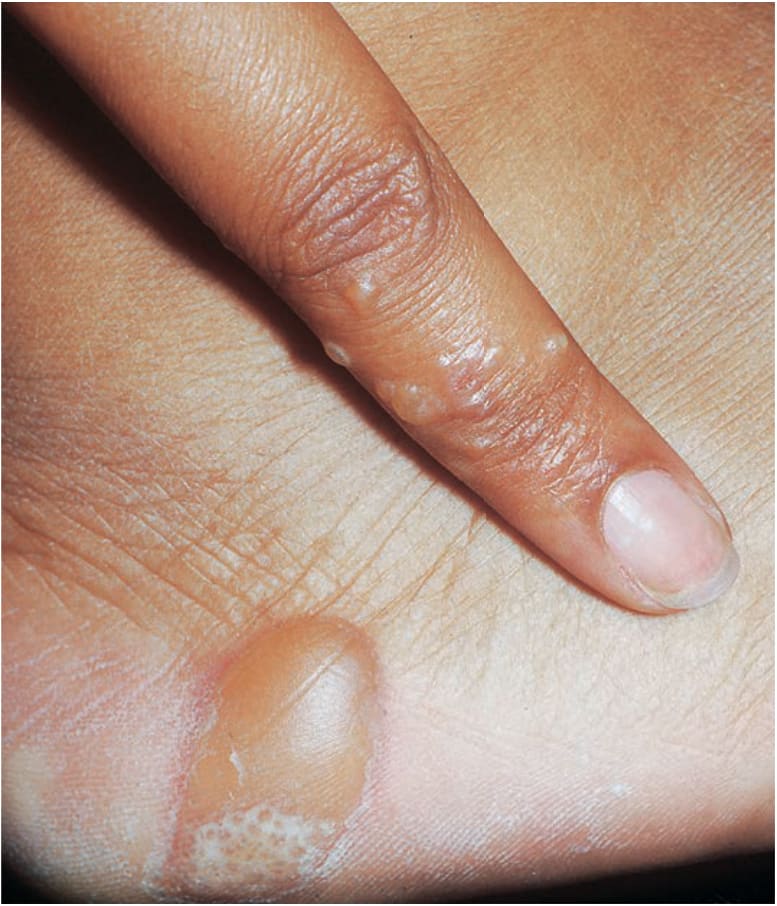
FIGURE 2-22 • Autosensitization dermatitis (“id” reaction): dermatophytid Vesicles and bullae on the finger and the lateral foot of a 21-year-old female. Bullous (inflammatory) tinea pedis was present and was associated with dermatophytid reaction. Prednisone was given for 2 weeks; pruritus and vesiculation resolved.