PEMPHIGOID GESTATIONIS (PG)
PEMPHIGOID GESTATIONIS (PG) ICD-10: L12.8
• A rare pruritic and polymorphic inflammatory bullous dermatosis of pregnancy and the postpartum period.
• Estimated incidence from 1 in 1700 to 1 in 10,000 deliveries.
• Extremely pruritic eruption mainly on the abdomen but also on other areas, with sparing of the mucous membranes. Lesions vary from erythematous, edematous papules, and urticarial plaques (Fig. 6-16) to vesicles and tense bullae (Fig. 6-16).
• Usually begins from the fourth to the seventh month of pregnancy, but can also occur in the first trimester and in the immediate postpartum period. May recur in subsequent pregnancies; if it does, it is likely to begin earlier.
• Pemphigoid gestationis (PG) can be exacerbated by the use of estrogen and progesterone-containing medications.
• Histopathologically, it is a subepidermal blistering condition with linear deposition of C3 along the basement membrane zone with concomitant IgG deposition in roughly 30% of patients.
• Serum contains IgG antibasal membrane antibodies, but these are detected in only 20% of patients by IIF. ELISA and immunoblotting assays detect autoantibodies in >70%, directed to BP180 (type XVII collagen) in hemidesmosomes (see Fig. 6-1). They are avid complement-fixing IgG1 antibodies that bind to the amniotic epithelial basement membrane.
• Some 5% of babies born to mothers with PG have urticarial, vesicular, or bullous lesions, which resolve spontaneously during the first weeks. There is a slight increase in premature and small-for-gestational-age births.
• Management: Prednisone at 0.5 mg/kg/d, but sometimes higher doses are required; during the postpartum period, taper gradually.
FIGURE 6-1 • Schematic of the components of dermal–epidermal basement membrane and levels of dermal–epidermal separation in hereditary and autoimmune bullous diseases with dermal–epidermal cleavage discussed in this Atlas EBS, epidermolysis bullosa simplex; BP, bullous pemphigoid; PG, pemphigoid gestationis; LAD, linear IgA disease; CP, cicatricial pemphigoid; EBA, epidermolysis bullosa acquisita; DEB, dermolytic epidermolysis bullosa. (Modified with permission from Marinkovich MP. Inherited epidermolysis bullosa. In: Goldsmith LA, Katz SI, Gilchrest BA, et al., eds. Fitzpatrick’s Dermatology in General Medicine. 8th ed. New York, NY: McGraw-Hill; 2012, pp. 649–665.)
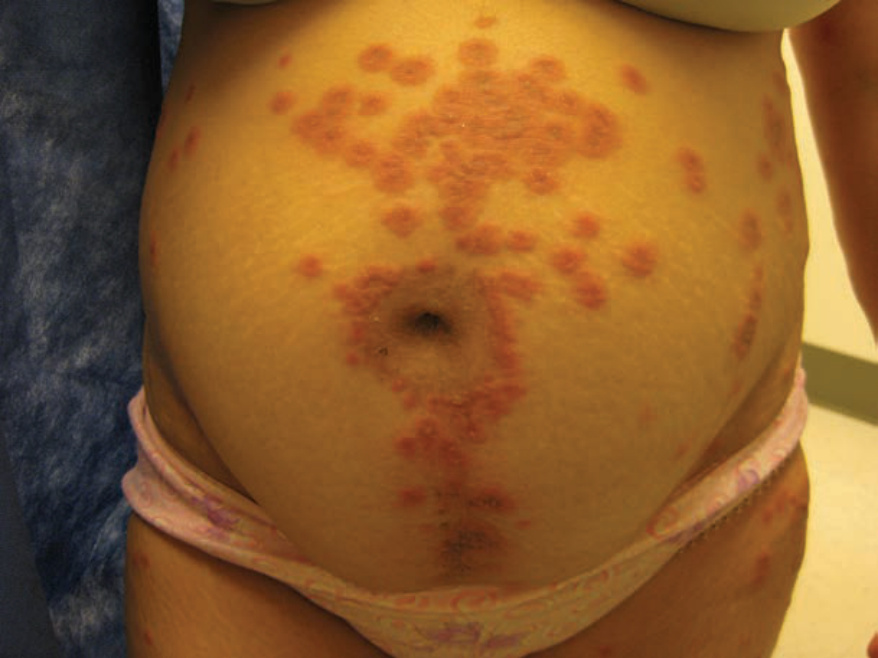
FIGURE 6-16 • Pemphigoid gestationis Erythematous urticarial and few tense vesicles, notice the periumbilical involvement.