NEVUS OF OTA
NEVUS OF OTA ICD-10: D22.301
• Very common in Asian populations and is said to occur in 1% of dermatologic outpatients in Japan. It has been reported in East Indians, African Americans, and, rarely, Caucasian.
• The pigmentation, which can be quite subtle or markedly disfiguring, consists of a mottled, dusky admixture of blue and brown hyperpigmentation of the skin. It mostly involves the skin and mucous membranes innervated by the first and second branches of the trigeminal nerve (Fig. 9-12).
• The blue hue results from the presence of ectopic melanocytes in the dermis. It can occur in the hard palate and in the conjunctivae (Fig. 9-12), sclerae, and tympanic membranes.
• Nevus of Ota may be bilateral. It may be congenital but is not hereditary; more often, it appears in early childhood or during puberty and remains for life, in contrast to the Mongolian spot, which may disappear in early childhood.
• Treatment with lasers is an effective modality for this disfiguring disorder.
• Malignant melanoma can occur but is very rare.
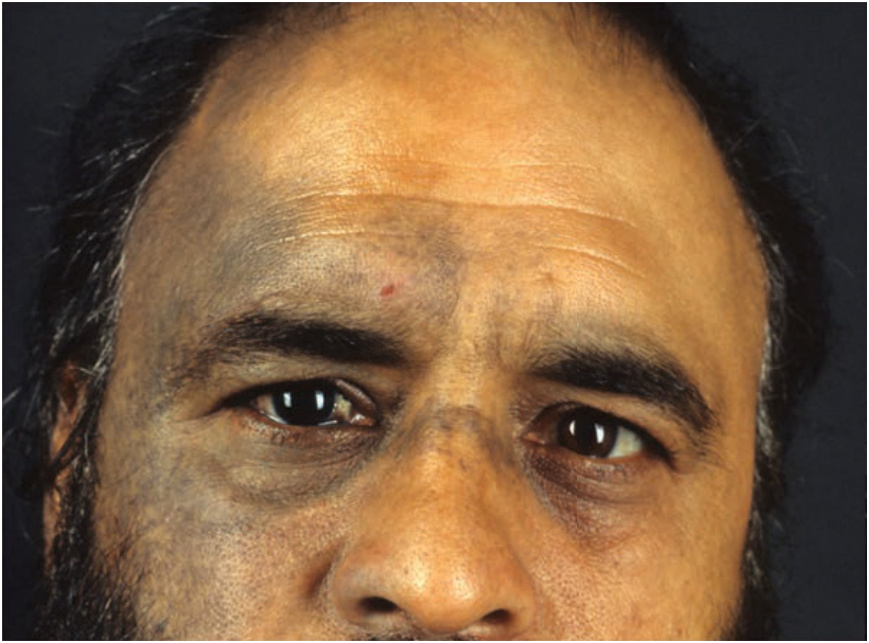
FIGURE 9-12 • Nevus of Ota There is an ill-defined, mottled, dusky, gray to bluish hyperpigmentation in the regions supplied by the first and second branches of the right trigeminal nerve. The lesion was unilateral and there was also hyperpigmentation of the sclera and eyelids.