SPIDER ANGIOMA
SPIDER ANGIOMA ICD-10: I78.11
• A very common red focal telangiectatic network of dilated capillaries radiating from a central arteriole (punctum) (Fig. 9-21A). The central papular punctum is the site of the feeding arteriole with macular radiating telangiectatic vessels.
• On diascopy, the radiating telangiectasia blanches and the central arteriole may pulsate.
• Most commonly occurs on the face, forearms, and hands.
• It is often a normal finding, and is more common in females; occurs in children.
• It may be associated with hyperestrogenic states, such as pregnancy (one or more in two-thirds of pregnant women), in patients receiving estrogen therapy, e.g., oral contraceptives, or in those with hepatocellular disease such as subacute and chronic viral hepatitis and alcoholic cirrhosis (Fig. 9-21B).
• Spider angioma arising in childhood and pregnancy may regress spontaneously.
• The lesion may be confused with hereditary hemorrhagic telangiectasia, ataxia-telangiectasia, or telangiectasia in systemic scleroderma.
• Lesions may be treated easily with electro- or laser surgery.
• Synonyms: Nevus araneus, spider nevus, arterial spider, spider telangiectasia, vascular spider.
A B
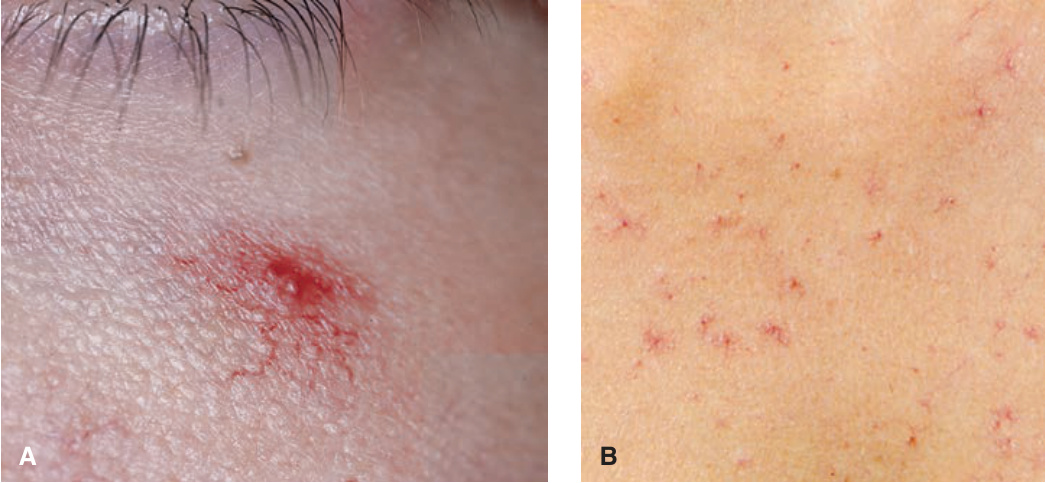
FIGURE 9-21 • Spider nevus (A) Two small papules from which telangiectasias radiate. Upon compression the lesion blanches completely. (B) Spider nevi on the chest of a patient with cirrhosis.