VENOUS LAKE
VENOUS LAKE ICD-10: L98.8
• A venous lake is a dark blue to violaceous, asymptomatic, soft papule resulting from a dilated venule, occurring on the face, lips, and ears of patients >50 years of age (Fig. 9-22A and B).
• Etiology unknown, but it has been related to solar exposure.
• Lesions are few in number and remain for years. A dilated cavity is lined with a single layer of flattened endothelial cells filled with red blood cells and surrounded by a thin wall of fibrous tissue.
• Because of its dark blue or sometimes even black color, the lesion may be confused with nodular melanoma, pigmented BCC, or pyogenic granuloma.
• The lesion can be partially compressed and lightened up by diascopy, and the use of dermoscopy assists its diagnosis as a vascular lesion.
• Management is for cosmetic reasons and can be accomplished with electrosurgery, laser, or, rarely, with surgical excision.
A B
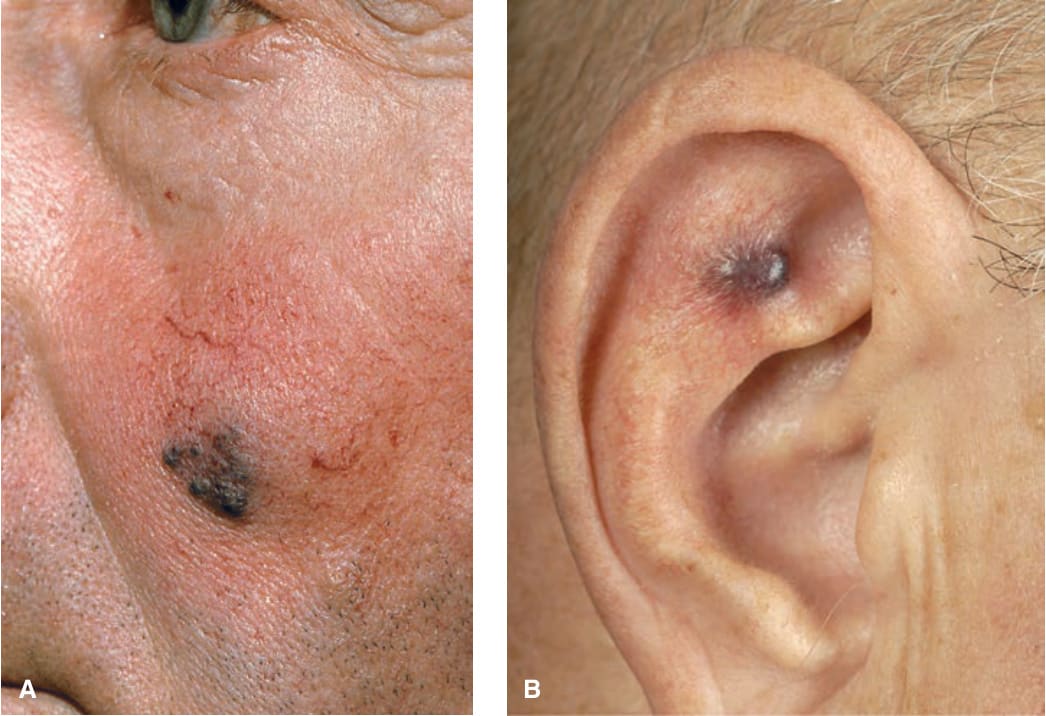
FIGURE 9-22 • Venous lake (A) On the cheek of a 70-year-old male. The lesion was almost black and became a matter of concern to the patient, who feared he might have melanoma. However, it blanched completely after compression. (B) Venous lake on the auricle of a 75-year-old male. The lesion is dark bluish-red and smooth resembling a basal cell carcinoma. It blanched upon compression.