LIPOMA
LIPOMA ICD-10: D17.910
• Lipomas are single or multiple, benign subcutaneous tumors that are easily recognized because they are soft, rounded, or lobulated and movable against the overlying skin (Fig. 9-47).
• Many lipomas are small but may also enlarge to >6 cm.
• They occur mostly on the neck, trunk, and on the extremities (Fig. 9-47) but can occur anywhere on the body.
• Lipomas are composed of fat cells that have the same morphology as normal fat cells within a connective tissue framework. Angiolipomas have a vascular component and may be tender in cold ambient temperature and with compression.
• Lesions can be excised.
• Familial lipoma syndrome, an autosomal-dominant trait appearing in early adulthood, consists of hundreds of slowly growing nontender lesions.
• Adipositas dolorosa, or Dercum disease, occurs in women in middle age; there are multiple tender, not circumscribed but rather diffuse fatty deposits.
• Benign symmetric lipomatosis, which affects middle-aged men, consists of many large nontender, coalescent poorly circumscribed lipomas, mostly on the trunk and upper extremities; they coalesce on the neck and may lead to a “horse-collar” appearance.
A B
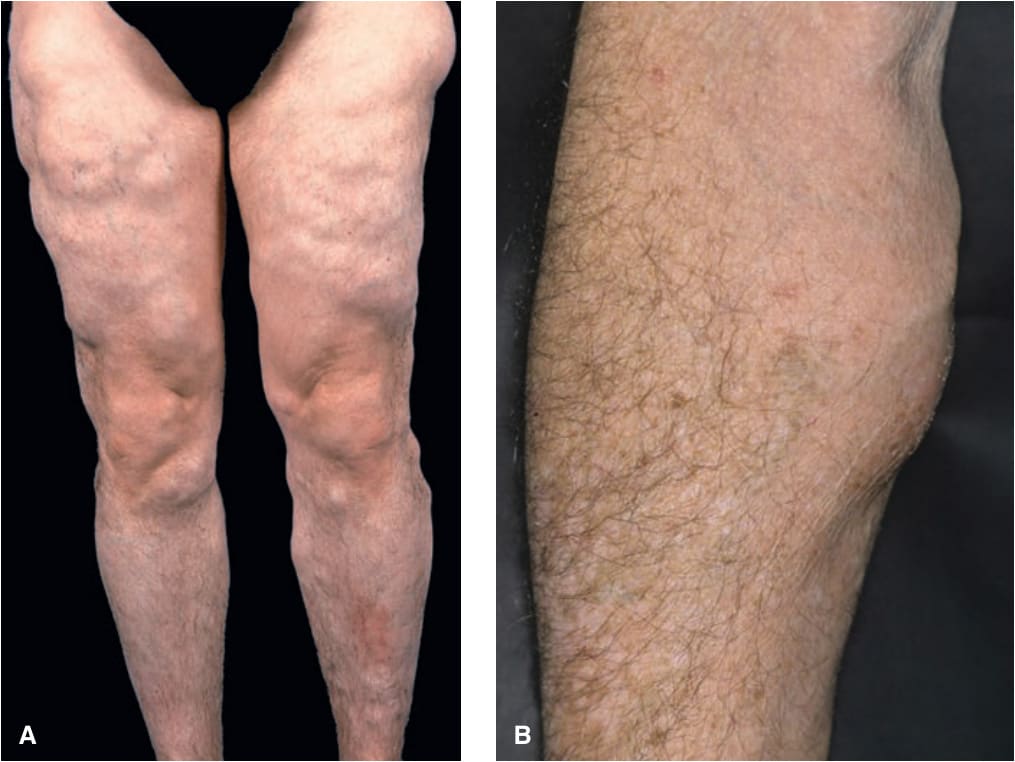
FIGURE 9-47 • Lipoma (A) Well-defined, soft, rounded tumors in the subcutis, movable both against the overlying skin and the underlying structures, in a 56-year-old male patient. In this patient, lesions were symmetric and were also found on the trunk and upper extremities. (B) Solitary lipoma on the lower arm of a 50-year-old patient.