KERATOACANTHOMA
KERATOACANTHOMA ICD-10: D23.L71
• KA is a special lesion; formerly considered a pseudocancer, it is now regarded by most as a variant of SCC.
• A relatively common, rapidly growing epithelial tumor with potential for tissue destruction and (rare) metastasis; however, in most cases there is spontaneous regression.
• HPV-9, -16, -19, -25, -37 have been identified in KAs; other possible etiologic factors include UVR and chemical carcinogens (pitch, tar).
• Age of onset over 40 years. Male:female ratio 2:1.
• A dome-shaped nodule with central keratotic plug (Fig. 11-17). Firm but not hard. Skin-colored, slightly red, brown. Removal of keratotic plaque results in a crater.
• Predilection for sun-exposed sites.
• Multiple KAs occur.
• Spontaneous regression in 6 to 12 months in most cases. However, local or visceral metastases have been detected.
• Histopathology: Not always possible to rule out highly differentiated SCC.
• Treatment is by excision.
A B
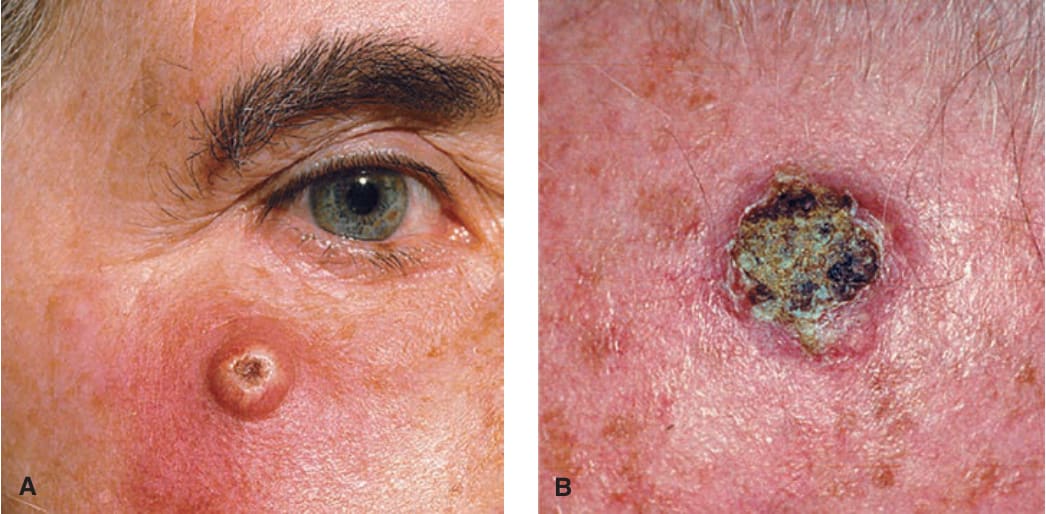
FIGURE 11-17 • Keratoacanthoma showing different stages of evolution (A) Initially there is a round domeshaped, very firm nodule, reddish with a central hyperkeratotic plug. This has been partially shed leaving a central crater. (B) Hyperkeratosis has progressed and has now replaced most of the nodule, leaving only a thin rim of tumor tissue in the periphery.