SCURVY
SCURVY ICD-10: E54.X00
• Scurvy is an acute or chronic disease caused by dietary deficiency of ascorbic acid (vitamin C).
• Scurvy occurs in infants or children on a diet consisting of only processed milk or in edentulous adult persons who do not eat salads and uncooked vegetables.
• Precipitating factors: Pregnancy, lactation, and thyrotoxicosis; most common in alcoholism.
• Symptoms of scurvy occur after 1 to 3 months cessation of vitamin C uptake. Lassitude, weakness, arthralgia, and myalgia.
• Skin lesions: Petechiae, follicular hyperkeratosis with perifollicular hemorrhage, especially on the lower legs (Fig. 15-15A). Hair becomes fragmented and buried in these perifollicular hyperkeratotic papules (corkscrew hairs, Fig. 15-15B); also, extensive ecchymoses (Fig. 15-15C), which can be generalized. Nails: splinter hemorrhages.
• Gingiva: Swollen, purple, spongy, and bleeds easily. Loosening and loss of teeth.
• Hemorrhage occurring into periosteum of long bones and into joints → painful swellings and, in children, epiphyseal separation. Sternum sinks inward: Scorbutic rosary (elevation at rib margins). Retrobulbar, subarachnoid, and intracerebral hemorrhage can cause death.
• Laboratory: Normocytic, normochromic anemia. Folate deficiency, resulting in macrocytic anemia. Positive capillary fragility test. Serum ascorbic acid level zero. X-ray findings are diagnostic.
• Unless treated, scurvy is fatal. On treatment, spontaneous bleeding ceases within 24 hours, muscle and bone pain fade quickly, bleeding from gums stops in 2 to 3 days.
• Management: Ascorbic acid 100 mg three to five times daily until 4 g is given; then 100 mg/d is curative in days to weeks.
A
C
B
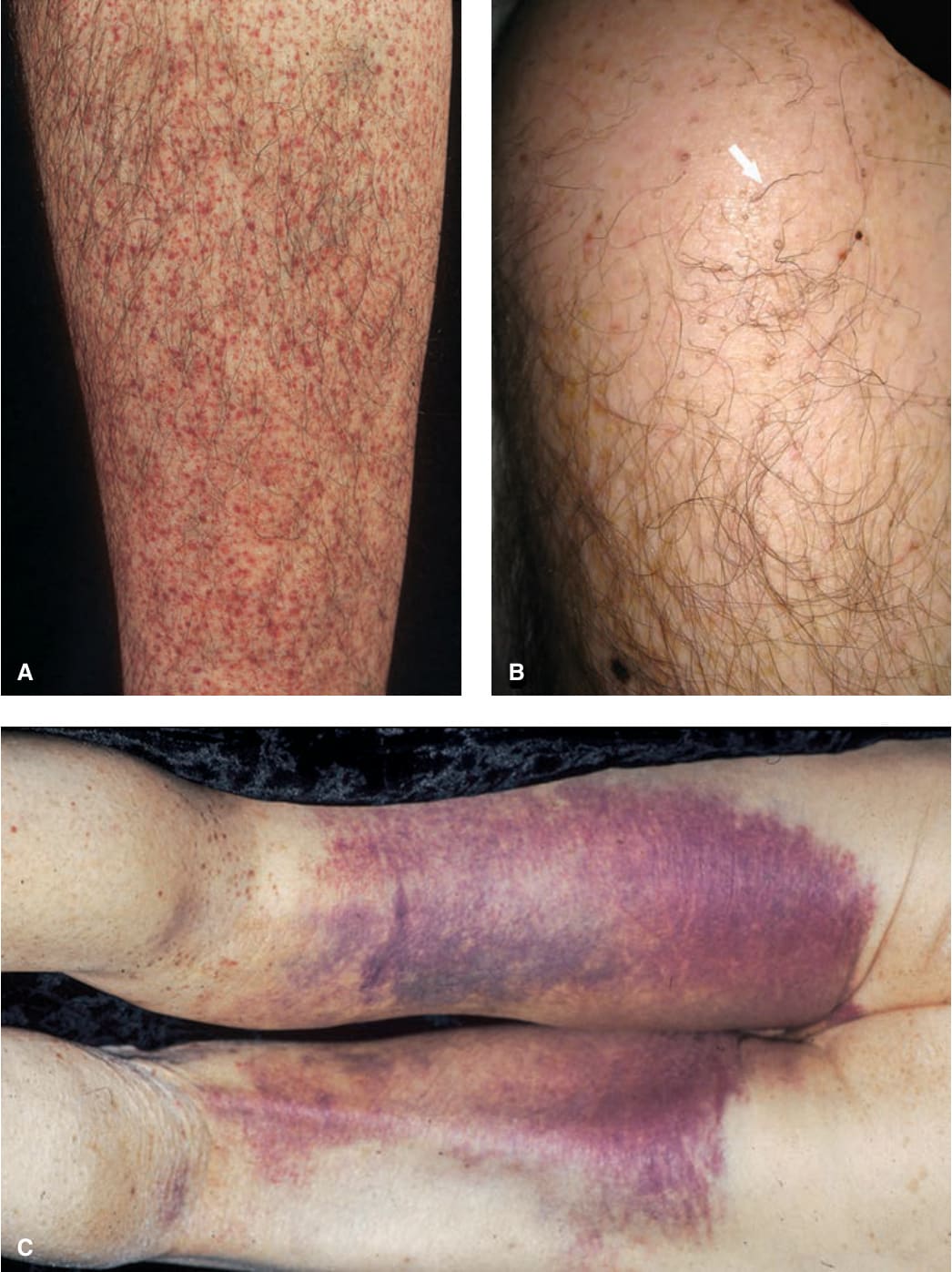
FIGURE 15-15 • Scurvy (A) Perifollicular purpura on the leg. The follicles are often plugged by keratin (perifollicular hyperkeratosis). This eruption occurred in a 46-year-old alcoholic, homeless male, who also had bleeding gums and loose teeth. (B) Perifollicular hyperkeratosis often lead to corkscrew hairs (arrow). (Used with permission from Adam Lipworth, MD.) (C) These extensive ecchymoses occurred in an edentulous 65-year-old male who lived alone and whose food intake consisted mainly of biscuits soaked in water.