HEREDITARY HEMORRHAGIC TELANGIECTASIA
HEREDITARY HEMORRHAGIC TELANGIECTASIA ICD-10: I78.0
• Hereditary hemorrhagic telangiectasia is an autosomal-dominant condition affecting blood vessels, especially in the mucous membranes of the mouth and the GI tract. It is caused by variants in genes involved in the TFG-β/BMP signaling cascade: ENG (codes for endoglin), ACVRL1 (cell surface receptor); SMAD4 (intracellular signaling molecule); GDF2 (growth factor).
• The disease is frequently heralded by recurrent epistaxis that appears often in childhood.
• The diagnostic lesions are small, pulsating, macular and papular, usually punctate, telangiectases (Figs. 16-11A and B) on the lips, tongue, face, palms/soles, fingers/ toes, nail beds, tongue, conjunctivae, nasopharynx, and throughout the GI and genitourinary tracts. In the 18-year-old male, shown in Figure 16-11A, there had been repeated epistaxis, but the telangiectasias had gone unnoticed until the patient was evaluated for anemia. Careful history revealed that the patient’s father had a minor form of the same condition.
• Pulmonary arteriovenous fistulas may occur.
• Chronic blood loss results in anemia.
• Electrocautery and pulse dye laser are used to destroy cutaneous and accessible mucosal lesions. Estrogens have been used to treat recalcitrant bleeding.
• Synonym: Osler–Weber–Rendu syndrome.
A B
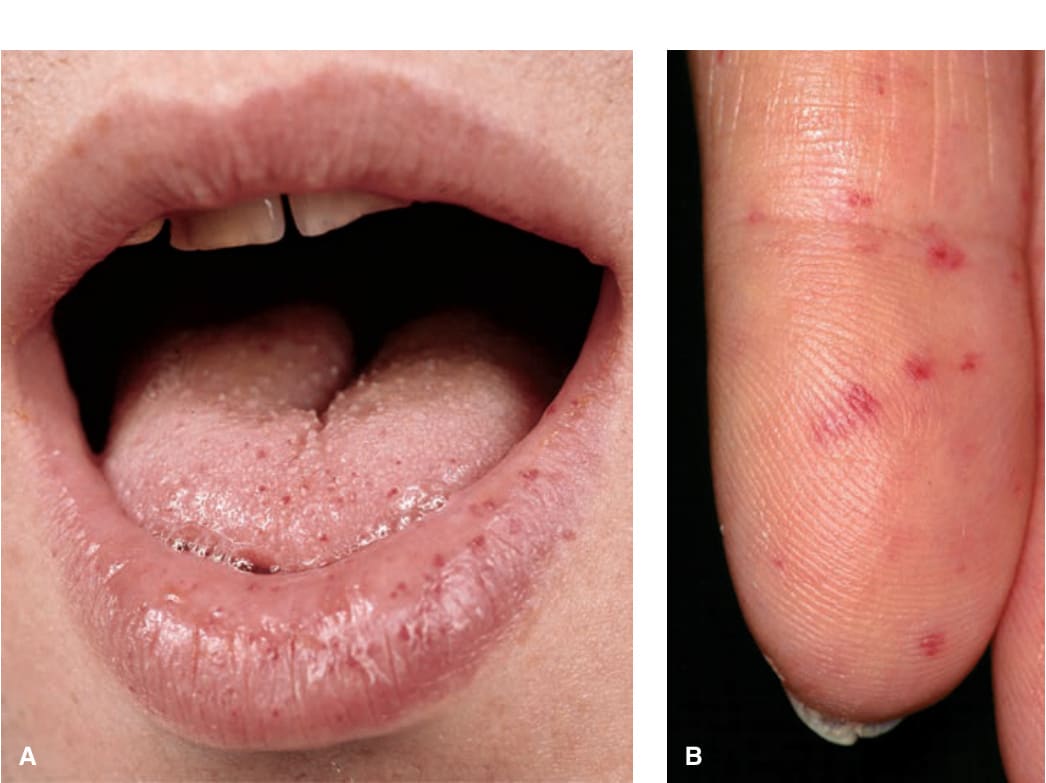
FIGURE 16-11 • Hereditary hemorrhagic telangiectasia (A) Multiple 1 to 2 mm, discrete, red macular and papular telangiectases on the lower lip and tongue. (B) Multiple pinpoint telangiectases on the index finger of another patient. Using dermatoscopy or a glass slide, the lesions can be shown to pulsate.