ANGIOSARCOMA
ANGIOSARCOMA ICD-10: c49.9
• Tumors are composed of cells lining blood vessels. Lymphangiosarcomas arise from cells lining lymphatic vessels. Cutaneous angiosarcomas can present anywhere on the skin but in elderly individuals, there is predilection for the scalp, face and neck. In the face, angiosarcoma may start as ecchymosis-like lesion (Fig. 21-21A). No racial predilection exists.
• When they occur at sites of chronic lymphedema, usually following radical mastectomy for treatment of breast cancer, the syndrome Stewart–Treves is diagnosed and often carries a worse prognosis.
• Clinically, tumors present as round blue or red nodules (Fig. 21-21B). In late presentations, several nodules may be noted, some with superficial erosion from rapid cell turnover.
• Histopathology shows a collection of jagged vessels, nuclear atypia, and pleomorphism. In highly de-differentiated tumors, vascular markers such as CD31, CD34, factor VIII, and Ulex can be helpful.
• Treatment is difficult. Surgical excision is indicated, depending on the clinical extent of the tumor. Surgical margin control is often difficult to obtain. Radiation therapy and chemotherapy are used in these cases. Recurrences are common. Prognosis is poor, particularly in Stewart–Treves.
A B
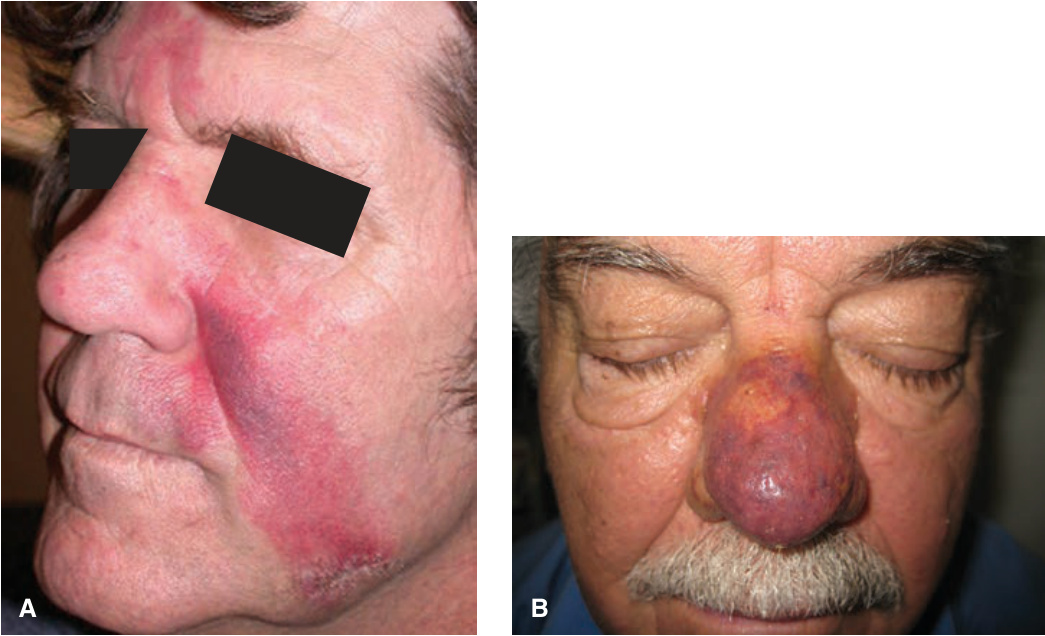
FIGURE 21-21 • Angiosarcoma (A) This unusual presentation resembling ecchymosis clearly follows a vascular pattern. Treatment is mostly palliative. (Used with permission from Maryam Asgari, MD.) (B) 69-year-old man with a deeply violaceous, indurated and edematous nose. More typical presentations include red nodules over an area that resembles ecchymoses.