FACTITIOUS SYNDROMES (MÜNCHHAUSEN SYNDROME)
FACTITIOUS SYNDROMES (MÜNCHHAUSEN SYNDROME) ICD-10: F 68.1
• The term factitious means “artificial,” and in this condition, there is a self-induced dermatologic lesion(s); the patient claims no responsibility or admits deliberately mutilating the skin.
• It occurs in young adults, females > males. The history of the evolution of the lesions is vague (“hollow” history).
• The lesions may be present for weeks to months to years.
• The patient may be normal looking and act normally in every respect, although frequently there is a strange affect.
• The skin lesions consist of cuts, ulcers, and dense adherent necrotic eschar (Fig. 24-5). The shape of the lesions may be linear, bizarre shapes, geometric patterns, single or multiple. The diagnosis can be difficult, but the nature of the lesions (bizarre geometric shapes) may immediately suggest an artificial etiology.
• It is important to rule out every possible cause—chronic infections, granulomas, and vasculitis—perform a biopsy before assigning the diagnosis of dermatosis artefacta for the benefit of the patient.
• There is often serious personality and/or psychosocial stress, or a psychiatric disease.
• The condition demands the utmost tact on the part of the physician, who can avert a serious outcome (i.e., suicide) by attempting to empathize with the patient to ascertain the cause.
• The condition may persist for years in a patient who has selected his or her skin as the target organ of his or her conflicts. Consultation and management with a psychiatrist are highly recommended.
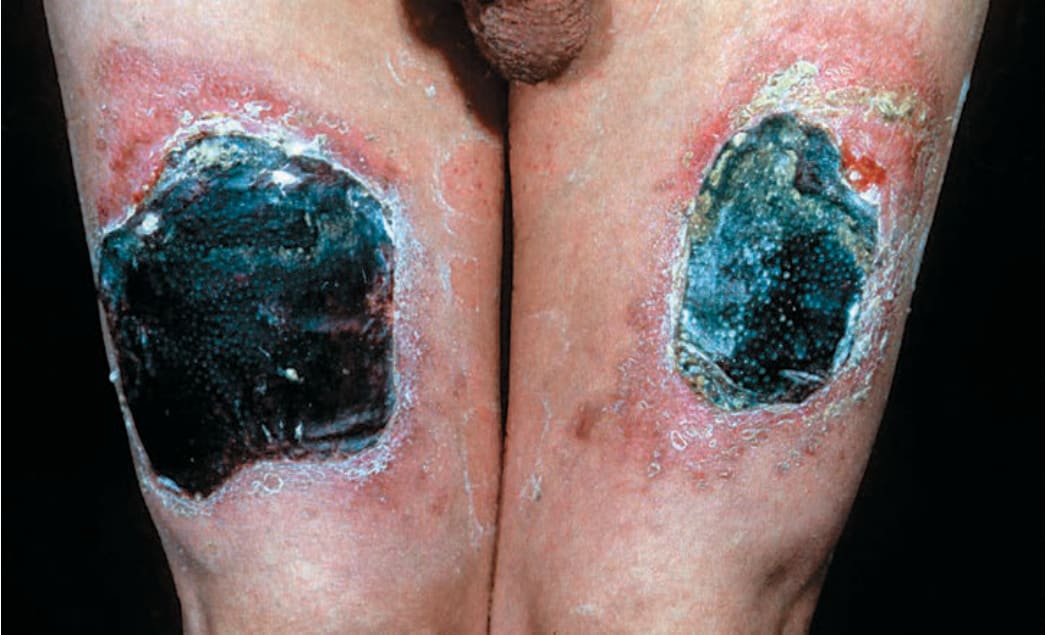
FIGURE 24-5 • Factitious syndrome These necroses were self-inflicted by the covert application of diluted sulfuric acid and tightly fitting bandages. The patient appeared well adjusted and refused to see a psychiatrist.