BACILLARY ANGIOMATOSIS (BA)
BACILLARY ANGIOMATOSIS (BA) ICD-10: A44.8
• Etiology. B. henselae, B. quintana. Both cause cutaneous angiomas. B. quintana causes subcutaneous nodules and lytic bone lesion.
• Demography. Occurs in advanced HIV disease. Incidence decreased with antiretroviral therapy (ART) and prophylaxis of opportunistic infections.
• Risk Factors. B. henselae: Contact with cats and/or cat fleas (C. felis). B. quintana: Low income, homelessness, body louse (P. humanis corporis) infestation.
CLINICAL MANIFESTATION
Papules or nodules resembling angiomas (bright red, violaceous, or skin colored) (Fig. 25-62); up to 2 to 3 cm in diameter; usually situated in dermis with thinning or erosion of overlying epidermis. Larger lesions may ulcerate. Subcutaneous nodules, 1 to 2 cm in diameter, resembling cysts. Uncommonly, abscess formation. Papules/nodules range from solitary lesions to >100. Firm, nonblanching. DISTRIBUTION Any site, but palms and soles are usually spared. Occasionally, lesions occur at the site of a cat scratch. A solitary lesion may present as dactylitis. MUCOUS MEMBRANES Angioma-like lesions of lips and oral mucosa. Laryngeal involvement with obstruction. SYSTEMIC FINDINGS Infection may spread hematogenously or via lymphatics to become systemic, commonly involving the liver (peliosis hepatitis) and spleen. Lesions may also occur in the heart, bone marrow, lymph nodes, muscles, soft tissues, and CNS.
DIFFERENTIAL DIAGNOSIS
Kaposi sarcoma, pyogenic granuloma, and cherry angioma.
DIAGNOSIS
Clinical findings confirmed by demonstration of Bartonella bacilli on the Warthin–Starry silver stain of lesional biopsy specimen, culture, or antibody studies.
COURSE AND TREATMENT
Rarely seen in persons with HIV disease successfully treated with ART. Untreated systemic infection causes significant morbidity and mortality. With effective antimicrobial therapy (erythromycin is treatment of choice;
occurring in HIV disease, relapse may occur and require lifelong secondary prophylaxis. alternatively, doxycycline), lesions resolve within 1 to 2 weeks. As with other infections
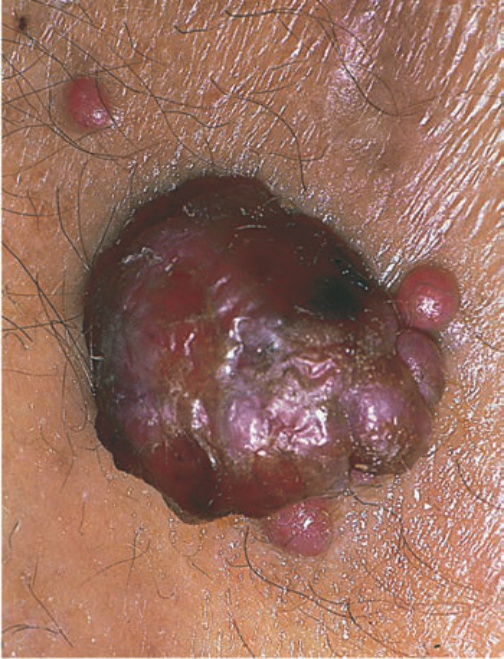
FIGURE 25-62 • Bartonellosis: Bacillary angiomatosis A 3- to 5-mm cherry hemangioma-like papules and a larger pyogenic granuloma-like nodule on the shin of a male with advanced HIV disease. Subcutaneous nodular lesions were also present. Lesion promptly resolved with oral erythromycin, but required secondary prophylaxis for recurrent lesions.