RUBELLA
RUBELLA ICD-10: B06
• Etiologic Agent. Rubella virus, an RNA togavirus.
• Clinical Manifestation. Characteristic exanthem and lymphadenopathy. Many infections are subclinical.
• Congenital Rubella Syndrome. Rubella virus infecting a pregnant woman, although causing a benign illness in the mother, may result in a serious chronic fetal infection and malformation.
• Prophylaxis. Childhood immunization is highly effective at preventing infection.
• Synonyms: German measles, “3-day measles.”
ETIOLOGY AND EPIDEMIOLOGY
ETIOLOGY Rubella virus, an RNA togavirus, member of Rubivirus genus. Attenuated rubella virus used in immunization can cause an illness with rubella-like rash, lymphadenopathy, and arthritis. DEMOGRAPHY Before widespread immunization, most commonly occurred in children <15 years. Currently young adults. Risk factors: Lack of active immunization and lack of natural infection. After immunization began in 1969, incidence decreased by 99% in industrialized countries. TRANSMISSION Inhalation of aerosolized respiratory droplets. Moderately contagious. Ten percent to 40% of cases asymptomatic. Period of infectivity from end of incubation period to disappearance of rash.
CLINICAL MANIFESTATION
PRODROME Prodrome usually absent, especially in young children. In adolescents and young adults: Anorexia, malaise, conjunctivitis, headache, low-grade fever, and mild upper respiratory tract symptoms. In women, rubella-like illness frequently follows administration of attenuated live rubella virus with arthralgias. EXANTHEM Pink macules, papules (Fig. 27-22). Initially on forehead, spreading inferiorly to the face, trunk, and extremities during the first day. By the second day, facial exanthem fades. By the third day, exanthem fades completely without residual pigmentary change or scaling. Truncal lesions may become confluent, creating a scarlatiniform eruption. MUCOUS MEMBRANES Petechiae on soft palate (Forchheimer sign) during prodrome (also seen in infectious mononucleosis).
LYMPH NODES Enlarged during prodrome. Postauricular, suboccipital, and posterior cervical lymph nodes enlarged and possibly tender. Mild generalized lymphadenopathy may occur. Enlargement usually persists for 1 week but may last for months. SPLEEN May be enlarged. JOINTS Arthritis in adults; possible effusion. Arthralgia, especially in adult women after immunization. CONGENITAL RUBELLA SYNDROME Congenital heart defects; cataracts; microphthalmia, microcephaly, hydrocephaly, and deafness.
DIFFERENTIAL DIAGNOSIS
EXANTHEM Other viral exanthems, ACDE, and scarlet fever. EXANTHEM WITH ARTHRITIS Acute rheumatic fever, rheumatoid arthritis, and erythema infectiosum.
DIAGNOSIS
Clinical diagnosis; can be confirmed by serology. Virus can be isolated from the throat, joint fluid aspirate.
COURSE
In most persons, rubella is a mild, inconsequential illness. However, when rubella occurs in a pregnant woman during the first trimester, the infection can be passed transplacentally to the developing fetus. Approximately half of infants who acquire rubella during the first trimester of intrauterine life will show clinical signs of damage from the virus.
TREATMENT
Rubella is preventable by immunization. Previous rubella should be documented in young women: If antirubella antibody titers are negative, rubella immunization should be given.
A
B
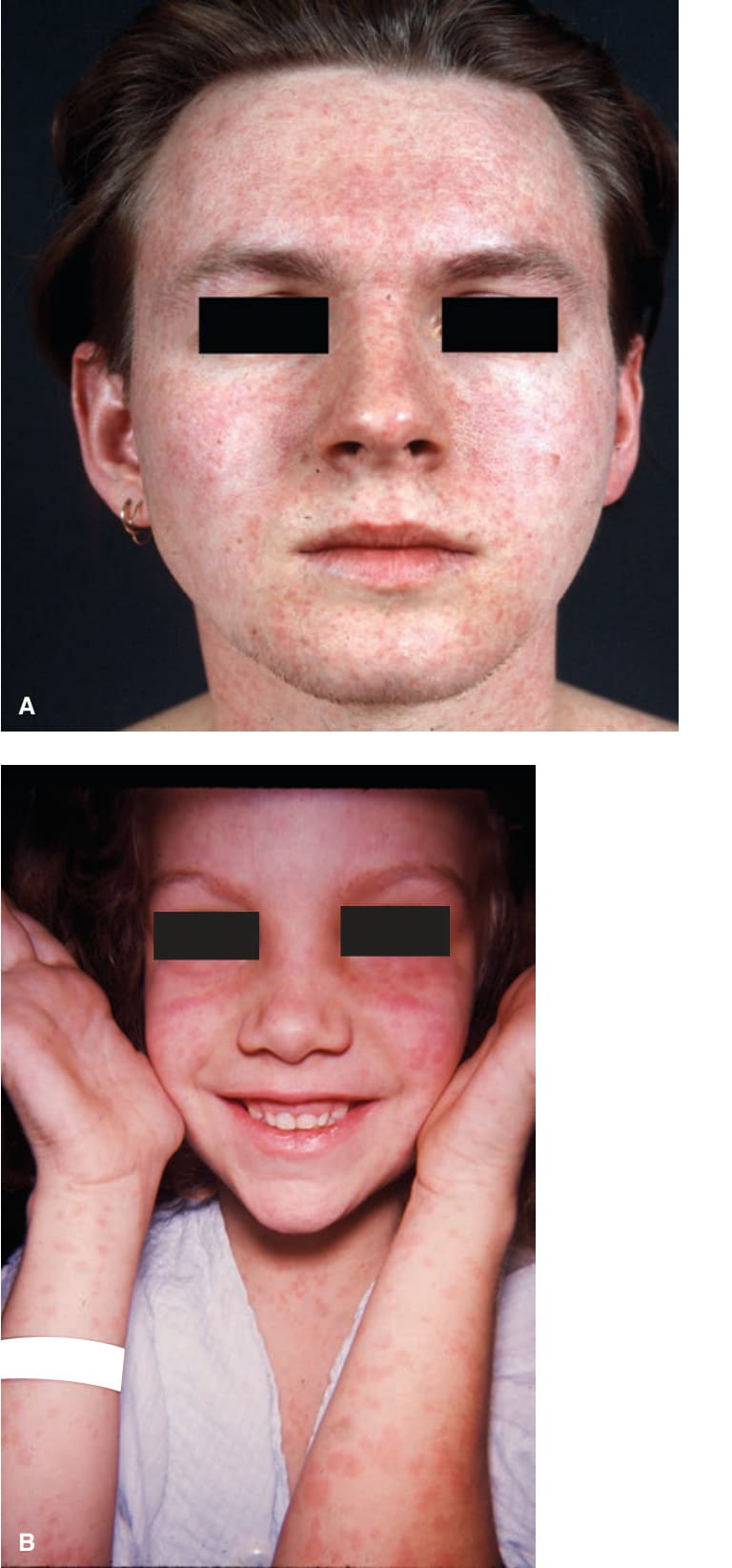
FIGURE 27-22 • A, B Rubella (A) Erythematous macules and papules appearing initially on the face and spreading inferiorly and centrifugally to the trunk and extremities, usually within the first 24 hours. Postauricular and posterior cervical lymph nodes were enlarged. Lesions becoming confluent on the cheeks while clearing on the forehead. Truncal lesions appear 24 hours after onset of facial lesions.