LEISHMANIASIS
LEISHMANIASIS ICD-10: B55
• Etiology. Many species of obligate intracellular protozoa Leishmania; predominant species are:
• New World: Leishmania mexicana complex, Viannia subgenus.
• Old World: L. tropica, L. major, and L. aethiopica.
• Vector. Sandflies. Old World: Phlebotomus. New World: Lutzomyia.
• Pathogenesis. Infection of macrophages in skin, naso-oropharyngeal mucosa, and the reticuloendothelial system (viscera). Diversity of clinical syndromes resulting from a particular parasite, vector, and host species.
CLINICAL SYNDROMES
Cutaneous leishmaniasis (CL) characterized by development of single or multiple cutaneous papules at the site of a sandfly bite, often evolving into nodules and ulcers, which heal spontaneously with a depressed scar.
• New World cutaneous leishmaniasis (NWCL).
• Old World cutaneous leishmaniasis (OWCL).
Diffuse (anergic) cutaneous leishmaniasis (DCL). Mucosal leishmaniasis (ML). Visceral leishmaniasis (VL); kala-azar; post–kala-azar dermal leishmaniasis (PKDL). Synonyms: NWCL: Chiclero ulcer, pian bois (bush yaws), uta. OWCL: Baghdad/Delhi boil or button, oriental/Aleppo sore/evil, bouton d’Orient. ML: Espundia. VL: Kala-azar (Hindu for black fever).
EPIDEMIOLOGY AND ETIOLOGY
Infection in humans is caused by 20 Leishmania species (Leishmania and Viannia subgenera). Stages of parasite: Promastigote:
Flagellated form found in sandflies and culture; amastigote: nonflagellated tissue form (2 to 4 µm in diameter); replicates in macrophage phagosomes in mammalian hosts. TRANSMISSION Vector-borne by bite of infected female phlebotomine sandflies, which become infected by taking blood meal from infected mammalian host. About 30 species of sandflies have been identified as vectors. They rest in dark, moist places, and are typically most active in evening and nighttime hours. Other modes: Congenital and parenteral (i.e., by blood transfusion, needle sharing, or laboratory accident). RESERVOIRS Varies with geography and leishmanial species. Zoonosis involves rodents/ canines. VECTORS Transmitted by 30 species of female sandflies of genera Lutzomyia (New World) and Phlebotomus (Old World). PREVALENCE An estimated 12 million people infected worldwide. According to the World Health Organization, there are 700,000– 1 million new cases each year. It is thought that children are more susceptible. GEOGRAPHY All inhabited continents except Australia; endemic in focal areas of
90 countries. Tropics, subtropics, and southern Europe. More than 90% of cases of CL occur in Afghanistan, Algeria, Iran, Iraq, Saudi Arabia, Syria, Brazil, and Peru. Climates: Range from deserts to rain forests, and from rural to urban. HOST DEFENSE DEFECTS Leishmania-specific anergy: Patients develop DCL. Poor immune response or immunosuppression (HIV disease): VL. Hyperergic variant: Leishmaniasis recidivans caused by L. tropica.
PATHOGENESIS
The clinical and immunologic spectrum of leishmaniasis parallels that of leprosy. CL occurs in a host with good protective immunity. MCL occurs in those with an intense inflammatory reaction. DCL occurs with extensive and widespread proliferation of the organism in the skin but without much inflammation or tendency for visceralization. VL occurs in the host with little immune response and/or in immunosuppression. Unlike leprosy, extent and pattern are strongly influenced by the specific species of Leishmania involved. Additional factors that affect the clinical picture: Number of parasites
A B
inoculated, site of inoculation, nutritional status of host, and nature of the last nonblood meal of vector. Infection and recovery are followed by lifelong immunity to reinfection by the same species of Leishmania. In some cases, interspecies immunity occurs.
CLINICAL MANIFESTATION
Primary lesions occur at site of sandfly bite, usually on the exposed site. INCUBATION PERIOD Inversely proportional to size of inoculum: Shorter in visitors to endemic area. OWCL: L. tropica major, 1 to 4 weeks; L. tropica, 2 to 8 months; acute CL: 2 to 8 weeks or more. SYMPTOMS Noduloulcerative lesions usually asymptomatic. With secondary bacterial infection, may become painful. NWCL L. mexicana complex. Small erythematous papule develops at sandfly bite site, evolving into ulcerated nodule (Fig. 29-1). Enlarges to 3 to 12 cm with raised border. Nonulcerating nodules may become verrucous. Lymphangitis, regional lymphadenopathy. Isolated lesions on the hand or head usually do not ulcerate. Eventually lesion heals with a depressed scar. Ear lesions may persist
for years, destroying cartilage (chiclero ulcers) (Fig. 29-2). ML Characterized by naso-oropharyngeal mucosal involvement, a metastatic complication of CL. Mucosal disease usually becomes evident several years after healing of original cutaneous lesions; cutaneous and mucosal
lesions can coexist or appear decades apart. Edema and inflammatory changes lead to epistaxis and coryzal symptoms. In time, the nasal septum, floor of the mouth, and tonsillar areas are destroyed (Fig. 29-3). Results in marked disfigurement (referred to as espundia in South America). Death may be caused by superimposed bacterial infection, pharyngeal obstruction, or malnutrition. OWCL Begins as small erythematous papule, which may appear immediately after sandfly bite but usually 2 to 4 weeks later. Papule slowly enlarges to 2 cm over a period of several weeks and assumes a dusky violaceous hue (Figs. 29-4 and 29-5). Eventually, lesion becomes crusted in center with a shallow ulcer and raised indurated border = volcano sign. In some cases, the center of the nodule becomes hyperkeratotic, forming a cutaneous horn. Small satellite papules may develop at periphery of lesion, and occasionally subcutaneous nodules along the course of proximal lymphatics. Peripheral extension usually stops after 2 months, and an ulcerated nodule persists for another 3 to 6 months, or longer. The lesion then heals with a slightly depressed scar. In some cases, CL remains active with positive
A
B
smears for 24 months (nonhealing chronic CL). The number of lesions depends on the circumstances of the exposure and extent of infection within the sandfly vector. May result in multiple lesions, up to 100 or more (Figs. 29-4 and 29-5). DCL Resembles lepromatous leprosy; large number of parasites in macrophages in dermis; no visceral involvement. In the Old World, occurs in 20% of individuals with leishmaniasis in Ethiopia and Sudan. In South America, attributed to a member of L. braziliensis complex. Presents as a single nodule, which then spreads locally, often through extension from satellite lesions, and eventually by metastasis. In time, lesions become widespread with nonulcerating nodules appearing diffusely over the face and trunk. Responds poorly to treatment. LEISHMANIASIS RECIDIVANS (LR) Complication of L. tropica infection. Dusky-red plaques with active, spreading borders and healing centers, giving rise to gyrate and annular lesions. Most
commonly affects the face; can cause tissue destruction and severe deformity. PKDL Sequel to VL that has resolved spontaneously or during/after adequate treatment. Lesions appear ≥1 year after course of therapy with macular, papular, nodular lesions, and hypopigmented macules/plaques on face (Fig. 29-6), trunk, and extremities. Resembles lepromatous leprosy when lesions are numerous. Develops in 20% of Indian patients treated for VL caused by L. donovani and in a small percentage of Ethiopian patients with VL caused by L. aethiopica. VL Can remain subclinical or become symptomatic, with acute, subacute, or chronic course. Inapparent VL cases outnumber clinically apparent cases. Malnutrition is risk factor for clinically apparent VL. Bone marrow, liver, and the spleen are involved. Term kala-azar (Hindi for “black fever,” some patients had gray color) refers to profoundly cachectic febrile patients with life-threatening disease. Patients present with fever, splenomegaly, pancytopenia, and wasting.
DIFFERENTIAL DIAGNOSIS
ACUTE CL Insect bite reaction, impetigo, ecthyma, furuncle, Mycobacterium marinum infection, furuncular myiasis, and chancre.
DIAGNOSIS
Clinical suspicion, confirmed by demonstrating:
• Intracellular nonflagellated amastigote in a biopsy of skin, mucosa, liver, lymph nodes, or aspirate of spleen, bone marrow, and lymph node.
• Flagellated promastigote in culture of tissues (requires up to 21 days).
COURSE
In general, NWCL tends to be more severe and progressive than OWCL. Visceral leishmaniasis is almost always fatal if untreated.
TREATMENT
Antimony-containing compounds meglumine antimoniate and sodium stibogluconate (see Fig. 29-4) are given systemically. Other drugs used to treat leishmaniasis: amphotericin B, miltefosine, paromomycin, and pentamidine.
A B
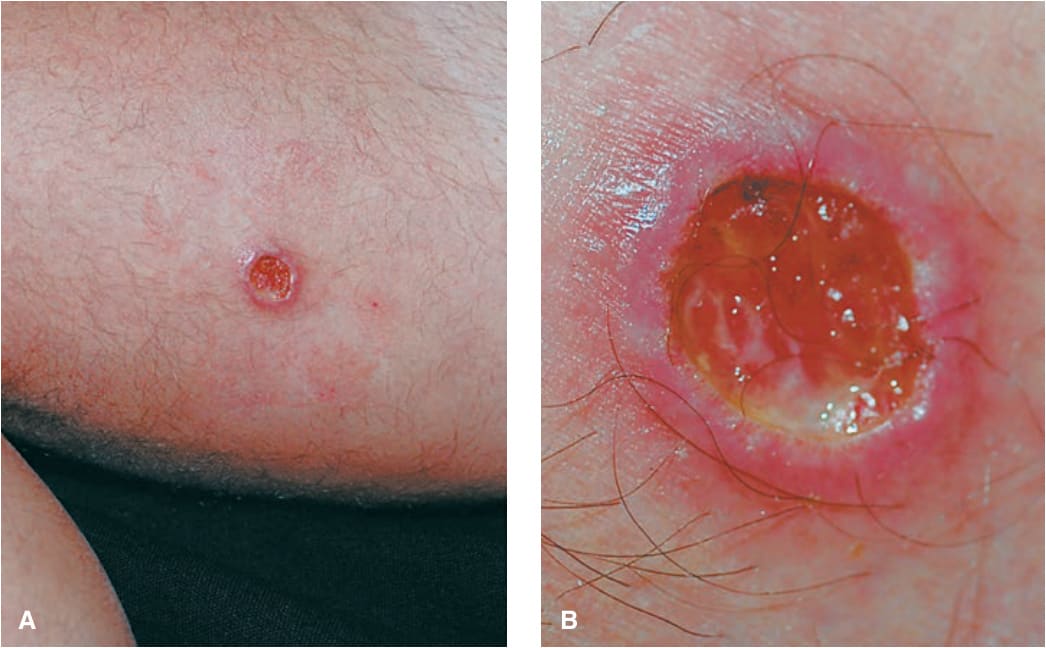
FIGURE 29-1 • (A, B) New World cutaneous leishmaniasis: Ulcer on thigh A 42-year-old with HIV disease noted a painless lesion on the medial thigh 6 weeks after returning from Mexico. Ulcer with rolled borders and base with granulation tissue. Leishmania were seen on lesional biopsy. L. mexicana was isolated on the tissue culture of lesional biopsy.
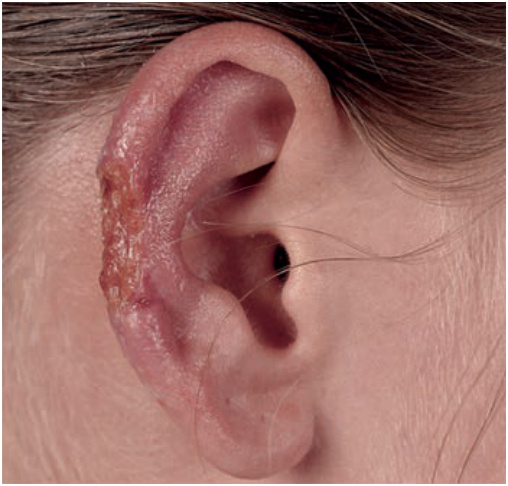
FIGURE 29-2 • New World cutaneous leishmaniasis: Chiclero ulcer A deep ulcer on the helix at the site of a sandfly bite. This variant typically occurs in leishmaniasis acquired in Central and South America.
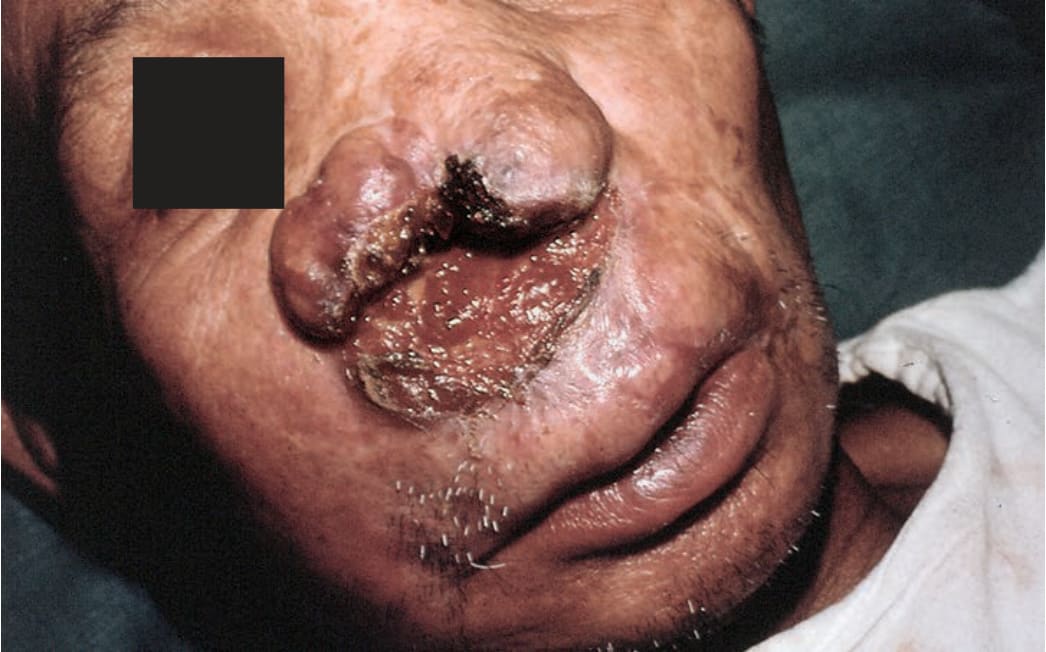
FIGURE 29-3 • Mucocutaneous leishmaniasis: Espundia Painful, mutilating ulceration with destruction of portions of the nose. (Used with permission from Eric Kraus, MD.)
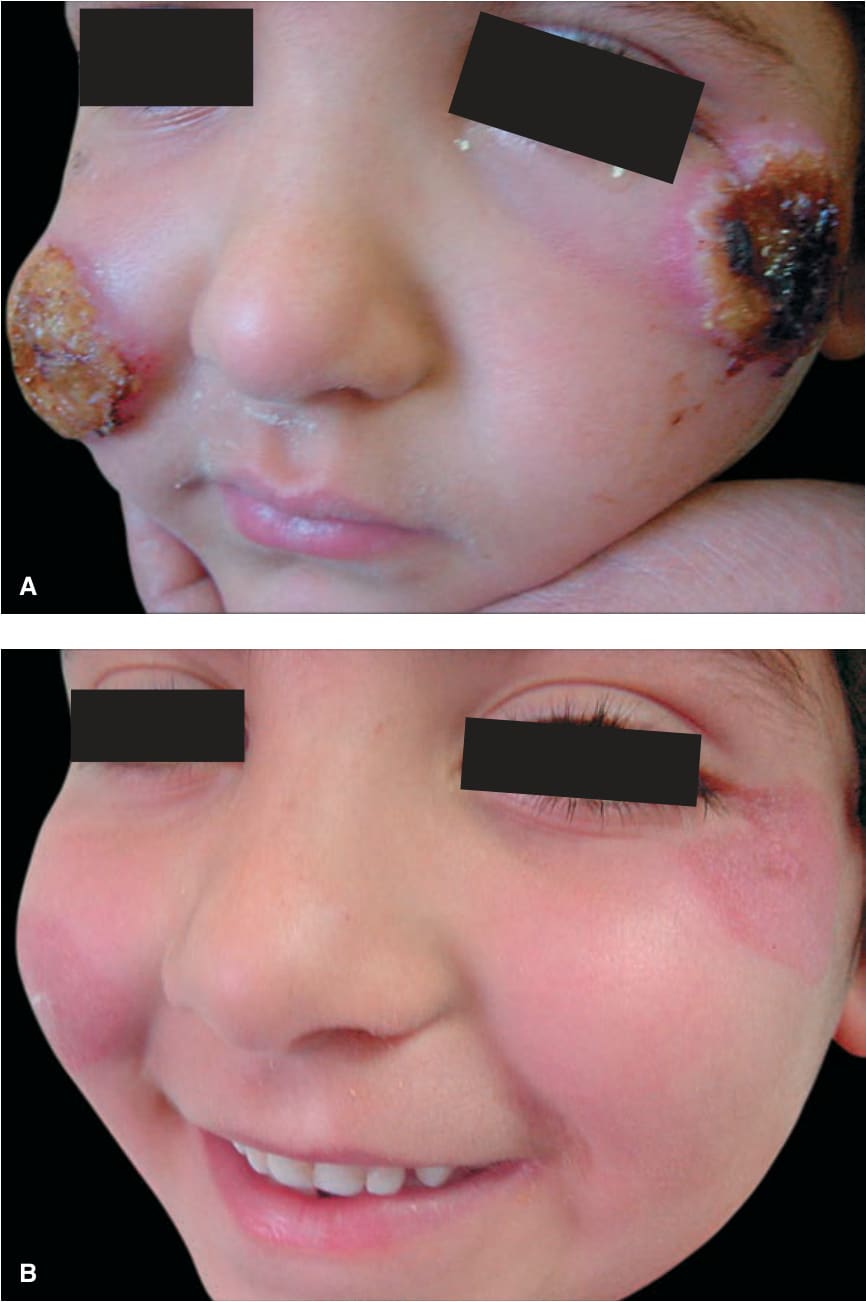
FIGURE 29-4 • Old World cutaneous leishmaniasis: Face A 7-year-old Jordanian girl with painful lesions on the cheeks for 6 weeks. (A) Large crusted nodules with surrounding edema on both cheeks. (B) 3 weeks after successful therapy (sodium stibogluconate pentostam injections; 15 mg/kg per day IM injection for 21 days), lesions have healed with minimal residual erythema and no scarring. (Used with permission from Mohammad Tawara, MD.)
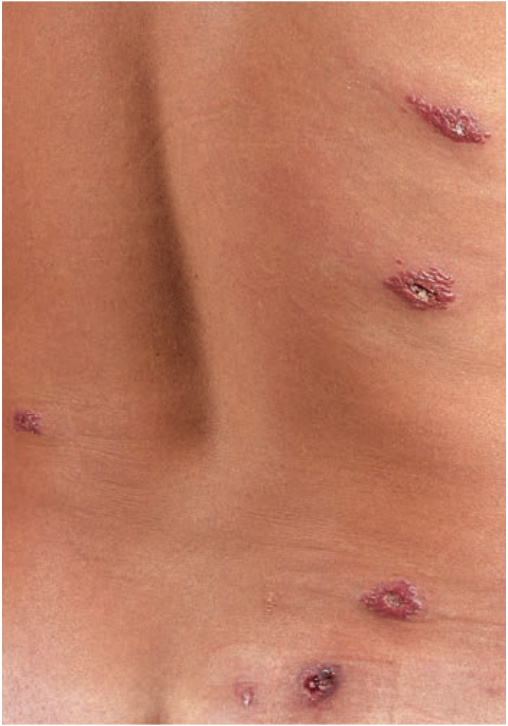
FIGURE 29-5 • Old World cutaneous leishmaniasis Multiple, crusted nodules on the exposed back, arising at sites of sandfly bites. Many of the lesions resemble a volcano with a central depressed center, i.e., volcano sign.
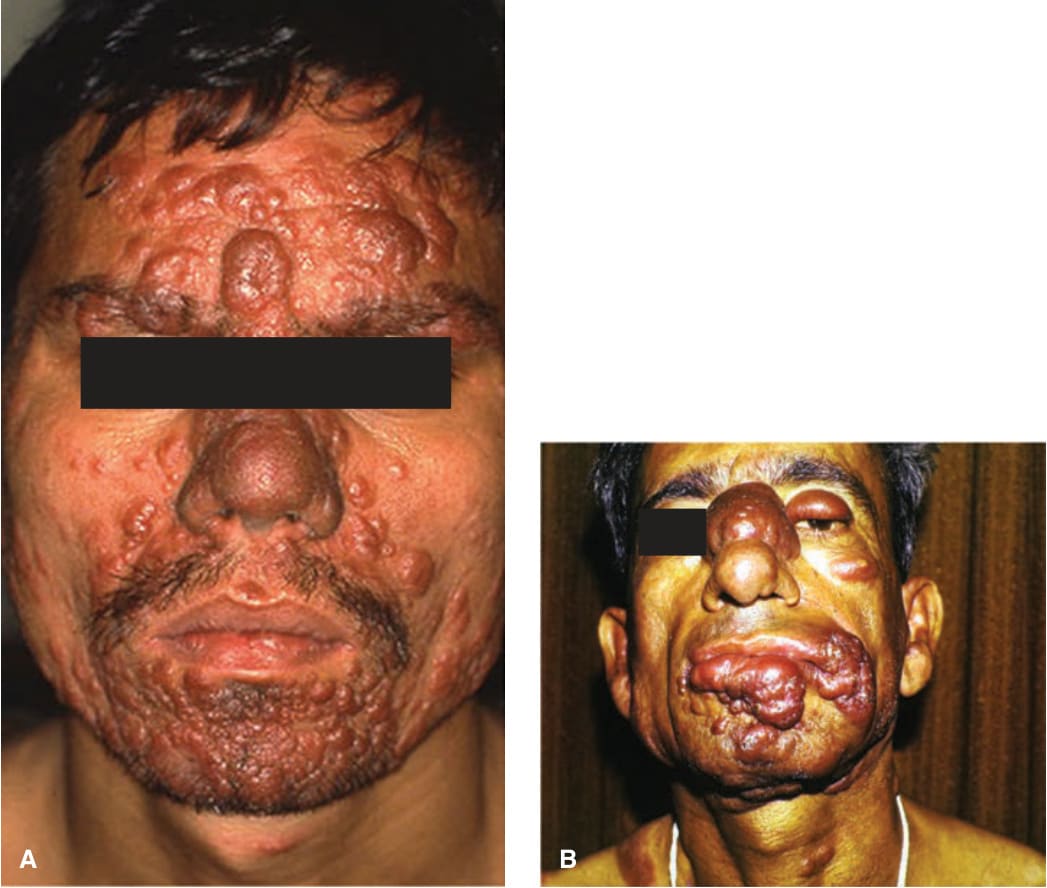
FIGURE 29-6 • Indian post–kala-azar dermal leishmaniasis (A) Coalescent erythematous dermal papules and nodules over the face in a picture similar to leonine facies. (Used with permission from Raj Kubba, MD.) (B) A 55-yearold Indian man with violaceous and deep red dermal nodules and tumors of the head and neck.