APHTHOUS ULCERATION
APHTHOUS ULCERATION ICD-10: K12.0
• Recurrent painful mucosal lesions.
• Most common cause of oral ulcerations; incidence up to 30% of otherwise healthy persons.
• May be associated with systemic diseases such as HIV/AIDS and Behçet disease.
EPIDEMIOLOGY
ETIOLOGY Idiopathic. Can arise at the site of minor mucosal injury, e.g., bite. PATHOGENESIS Cell-mediated immune reaction pattern. AGE AT ONSET Any age; often during second decade, persisting into adulthood, and becoming less frequent with advancing age.
Classification
• Simple: 1 to 3 oral ulcers that recur 1 to 3 times per year.
• Complex: Continuous ulcers and associated with systemic disease or genital ulcers.
• Major aphthous ulcers (AU) may persist for ≥6 weeks, healing with scarring.
• Behçet disease should be considered in patients with persistent oropharyngeal AU, with or without anogenital AU, associated with systemic findings (eye, nervous system). See Section 14.
CLINICAL MANIFESTATION
SYMPTOMS Even though small, AU can be quite painful. In persons with severe AU, weight loss may be associated with persistent pain.
Mucosal Findings
• At times, small, painful red macule or papule before ulceration.
• More commonly, ulcer(s) <1 cm (Figs. 33-10 and 33-11), covered with fibrin (gray-white),
with sharp, discrete, and at times edematous borders.
• Herpetiform “or grouped” AU (HAU) and major AU (MaAU) may heal with white, depressed scars.
• Number of ulcers: Minor AU (MiAU), 1 to 5; MaAU, 1 to 10; HAU, up to 100.
• Distribution: Oropharyngeal, anogenital, any site in the GI tract. Oral lesions most commonly on the buccal and labial mucosa, less commonly on tongue, sulci, and floor of mouth. MiAU rarely occur on the palate or gums. MaAU often occur on soft palate and pharynx. Also, esophagus, upper and lower GI tract, and anogenital epithelium.
GENERAL FINDINGS With MaAU, occasionally tender cervical lymphadenopathy. ASSOCIATED DISORDERS Behçet disease, cyclic neutropenia, acute HIV, AIDS (large chronic AU), reactive arthritis; Crohn disease;
periodic fever, aphthous stomatitis, pharyngitis, and adenitis syndrome (PFAPA). The latter occurs in young children with associated high fever occurring periodically every 3 to 5 weeks with AU, pharyngitis, and/or lymphadenitis.
DIFFERENTIAL DIAGNOSIS
Primary herpetic gingivostomatitis, handfoot-and-mouth disease, herpangina, primary HIV/AIDS infection, Behçet disease, squamous cell carcinoma (SCC), bullous disease, lichen planus, reactive arthritis (Reiter) syndrome, and adverse drug reaction.
LABORATORY
DERMATOPATHOLOGY Nondiagnostic. Rule out specific cause of ulcer, i.e., infection (syphilitic chancre, histoplasmosis, and herpes),
inflammatory disorders (lichen planus), or cancers (SCC).
DIAGNOSIS
Usually made on clinical findings, ruling out other causes.
COURSE
Tend to recur during adulthood. Uncommonly, may be almost constant in the oropharynx or anogenitalia, referred to as complex aphthosis.
MANAGEMENT Topical Therapy Topical high potency steroids, sucralfate. Lidocaine gel can provide short term pain relief Intralesional triamcinolone (3 to 10 mg/ mL) with lidocaine is a very effective treatment option.
Systemic Therapy
• Prednisone: In persons with large, persistent, painful AU interfering with nutrition, a brief course of prednisone can be effective, starting 1 mg/kg, tapering over 2 to 3 weeks.
• Dapsone—starting at 50 mg daily with a maximum dose of 150 mg daily. A baseline glucose-6-phosphate dehydrogenase (G6PD) level is recommended, with monitoring of CBC.
• Colchicine—starting at 0.6 mg daily increasing to twice daily if tolerated. Can cause GI distress.
• Thalidomide: Effective in HIV/AIDS, Behçet disease, and large painful AU. Adverse effects: Peripheral sensory neuropathy. Teratogenesis.
• Tumor necrosis factor-αinhibitor: Adalimumab and infliximab reported to be effective. Interleukin-1 inhibition shows promise for PFAPA.
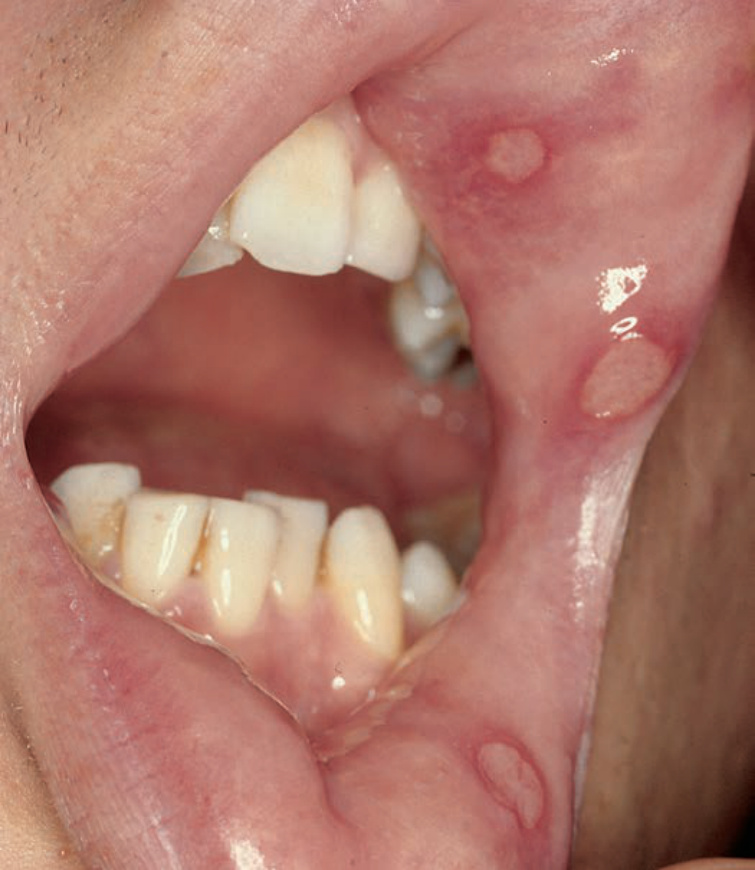
FIGURE 33-10 • Aphthous ulcers: Minor Multiple, very painful, gray-based ulcers with erythematous halos on the labial mucosa.
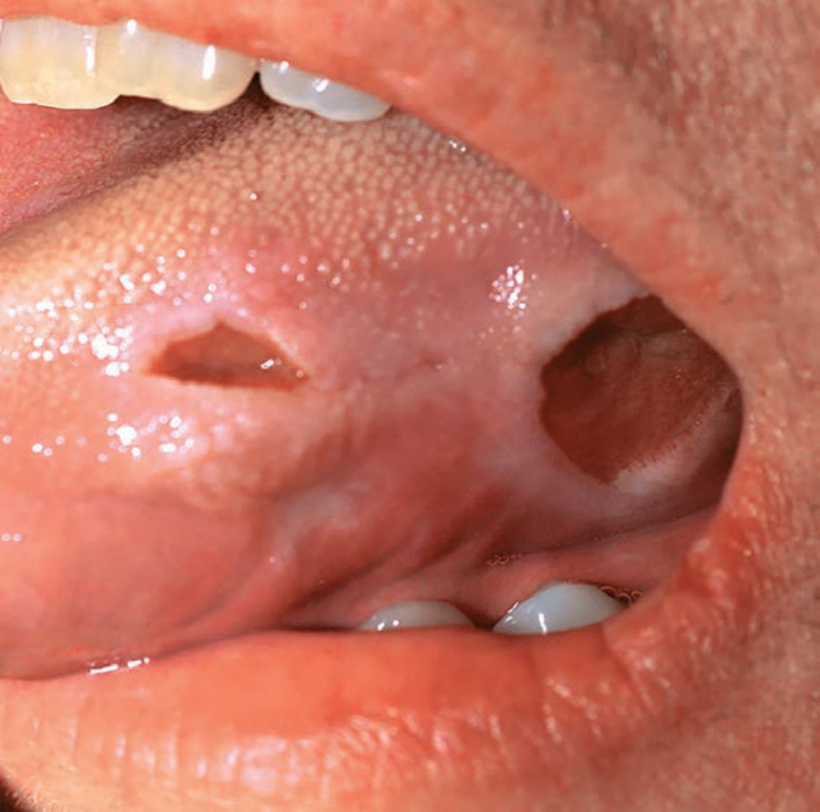
FIGURE 33-11 • Aphthous ulcers: Major Two large painful deep ulcers on the lateral tongue are seen in a patient with HIV/AIDS. Ulcers resolved with intralesional triamcinolone injection.